 Sofa VoyageSuomeksi
Abu Dhabi
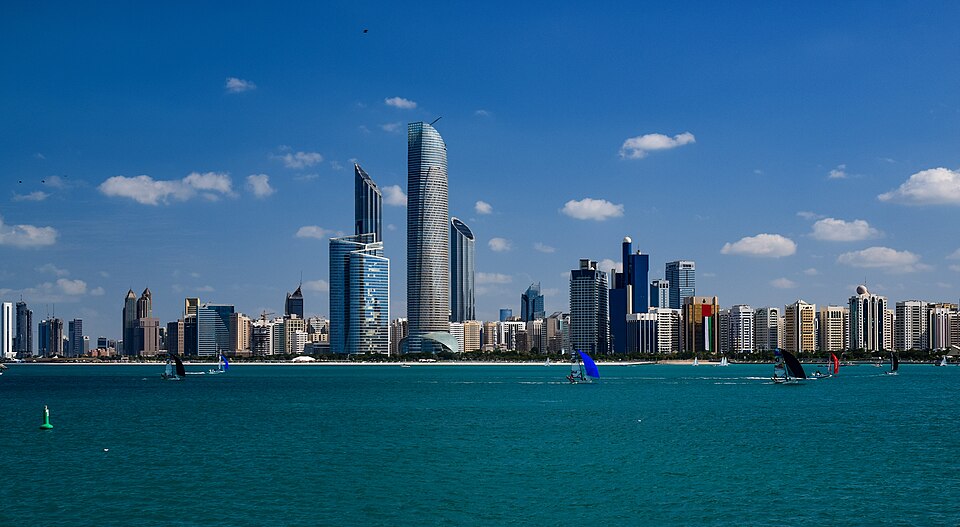
Welcome to Abu Dhabi, capital of the United Arab Emirates. The city sits on a T-shaped island reaching into the Persian Gulf from the central-western coast of the country, although much of the city lies on the mainland. Abu Dhabi is the second most populous city in the Emirates after Dubai, and its oil and gas wealth has turned it into a large, modern metropolis. The Abu Dhabi Investment Authority, based here, is estimated to manage around a trillion US dollars in assets. From gleaming domes to the city's oldest stone fort, let us begin our tour.
Sights
Sheikh Zayed Grand Mosque
Before you rises the Sheikh Zayed Grand Mosque, the largest mosque in the country. It was built between 1994 and 2007, and the complex covers more than 12 hectares. Its main axis is turned about 12 degrees south of true west, so that it faces the Kaaba in Mecca. The project was launched by Sheikh Zayed bin Sultan Al Nahyan, the late president of the Emirates, who wanted a building that would unite the cultural diversity of the Islamic world. When he died in 2004, he was buried in the mosque's own courtyard. One of the minarets even houses a library of rare books on Islamic arts and sciences.
Louvre Abu Dhabi
On Saadiyat Island stands the Louvre Abu Dhabi, an art museum born of an agreement between the Emirates and France signed in March 2007. That agreement allows it to use the Louvre's name until 2047, and the Louvre itself has called it France's largest cultural project abroad. With 8,000 square metres of galleries, it is the largest art museum on the Arabian Peninsula. Its collection brings together works from around the world, with the stated aim of bridging Eastern and Western art. By 2019 it had already welcomed 2 million visitors.
Emirates Palace
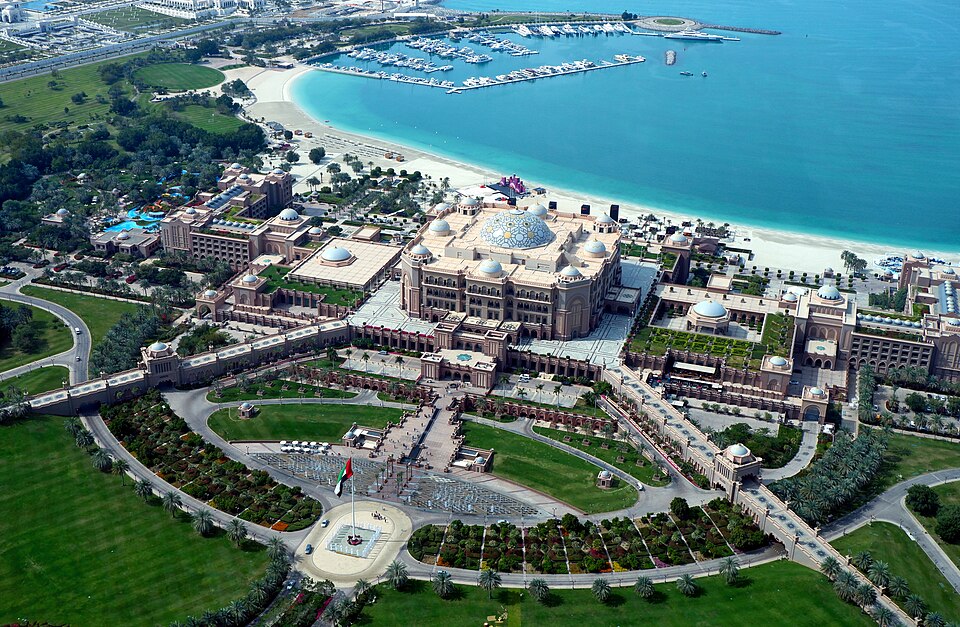
Photo: Chris Down · CC BY 4.0 · Wikimedia Commons Now gaze at the Emirates Palace, a luxury five-star hotel designed to blend modern construction with Islamic architectural elements such as symmetry and geometric patterns. Above it rise a central patterned dome and 114 smaller domes, and the exterior colour was inspired by the sand of the Arabian Desert. Construction began in December 2001, and at a cost of about 3 billion US dollars, it was the third most expensive hotel ever built. Inside are 390 residences, including 92 suites.
Qasr Al Watan
This is Qasr Al Watan, whose name means Palace of the Nation. It is the presidential palace of the United Arab Emirates, but nobody lives here. Instead it hosts state receptions for foreign leaders and meetings of the Council of Ministers. Construction was completed in 2017, and for its first years the palace served official purposes only. On 11 March 2019 it opened its doors to the public as well, yet it still carries on its role as a stage for the country's diplomacy.
Ferrari World
Photo: Ferrari S.p.A. · Public domain · Wikimedia Commons Feel the roar of Ferrari World on Yas Island, a mostly indoor theme park and the first in the world dedicated to Ferrari. It opened on 4 November 2010 after three years of development, and it forms part of a larger entertainment complex that also includes a water park and the Yas Marina Circuit. Its star attraction is Formula Rossa, a roller coaster that held the record as the world's fastest from 2010 until another ride, Falcons Flight, took the title.
Qasr al-Hosn

Photo: Peturrunar · CC BY-SA 4.0 · Wikimedia Commons Here is Qasr Al Hosn, the oldest stone building in Abu Dhabi. It began in 1761 as a cone-shaped watchtower guarding the only freshwater well on the island. In 1793 the ruler Shakhbut bin Dhiyab Al Nahyan expanded it into a small fort, and it became the permanent home of the ruling sheikh. Its present shape came from a major extension in the late 1930s, paid for with revenue from Abu Dhabi's first oil licence. It is often called the White Fort, yet it was not originally white at all; it was painted bright white during renovations between 1976 and 1983.