 Sofa VoyageSuomeksi
Brasília
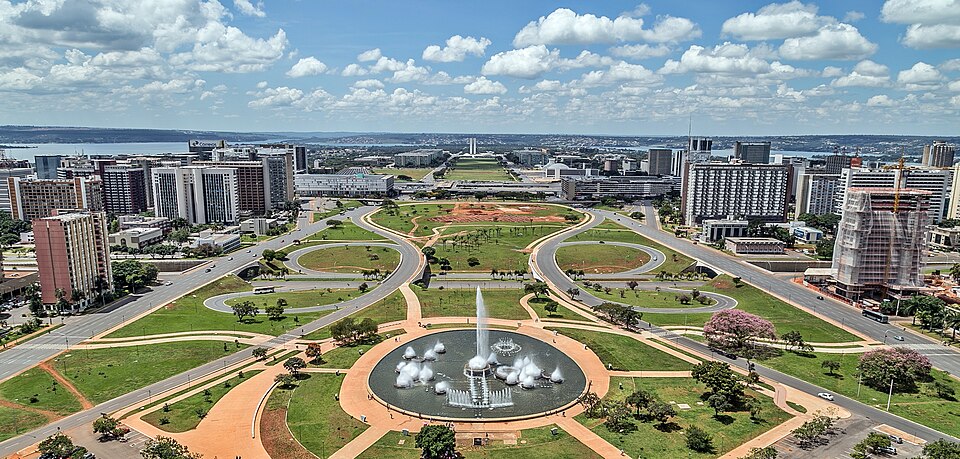
Welcome to Brasília, the capital of Brazil, high on the Brazilian Highlands in the country's Central-West. This is a planned city, created by Lúcio Costa, Oscar Niemeyer and Joaquim Cardozo, and founded by President Juscelino Kubitschek on 21 April 1960 to replace Rio de Janeiro as capital. Seen from above, it is laid out in the shape of an aeroplane: the fuselage is the Monumental Axis, and in the cockpit lies the Three Powers Plaza. Its white modernist architecture made it a UNESCO World Heritage Site in 1987. Let's explore Niemeyer's city.
Sights
Cathedral of Brasília
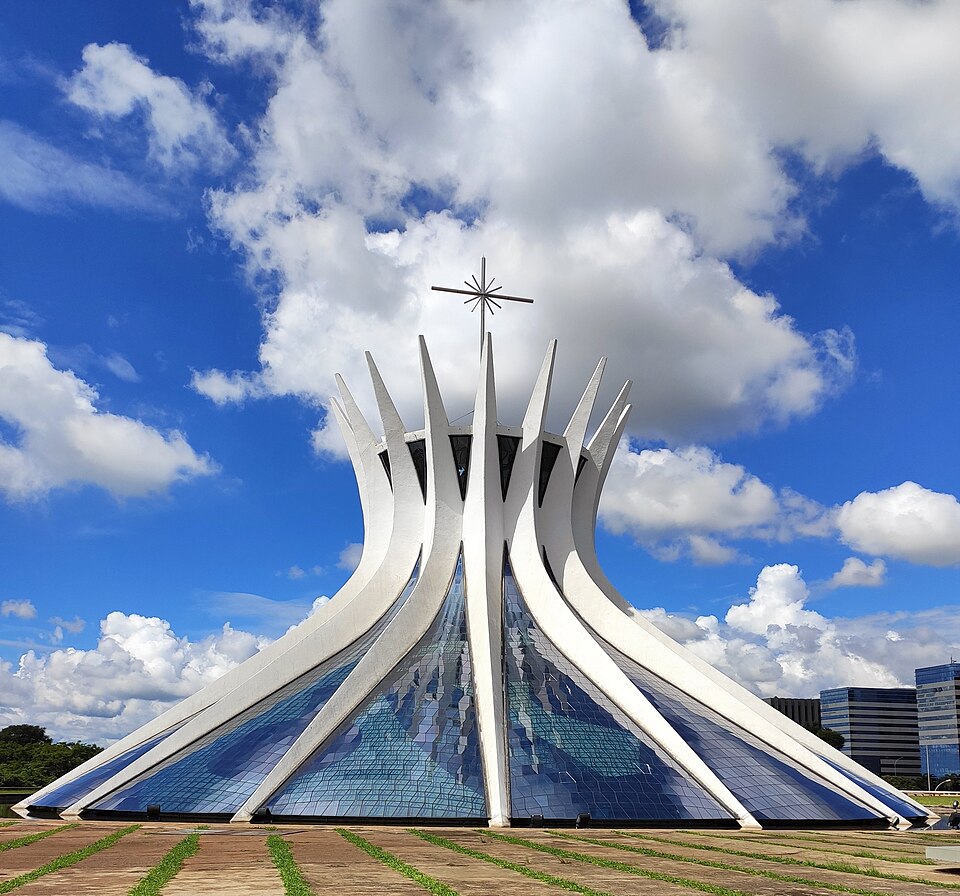
Photo: Tissiana de A. de Souza · CC BY-SA 4.0 · Wikimedia Commons In front of you rises the Cathedral of Brasília, designed by Oscar Niemeyer, engineered by Joaquim Cardozo and dedicated in 1970. Its shape is a hyperboloid formed by 16 concrete columns, each weighing 90 tonnes. Four bronze statues of the Evangelists, 2.5 metres tall, greet you on the way in, and a 20 metre bell tower stands to the right with bells cast in Spain. Here is the surprise: a shallow reflecting pool 12 metres wide surrounds the roof and helps cool the building, and you actually pass beneath it as you enter.
Praça dos Três Poderes

Photo: Ivano Gutz · CC BY-SA 3.0 · Wikimedia Commons You are standing in the cockpit of the city plan, the Praça dos Três Poderes, or Three Powers Plaza. Around you stand the three branches of government: the Palácio do Planalto for the executive, the National Congress for the legislature, and the Supreme Federal Court for the judiciary. Lúcio Costa and Oscar Niemeyer designed it as a place where the three powers would meet in harmony. Look up at the giant Brazilian flag, weighing about 90 kilograms. Apart from its monthly replacement, it has never been taken down since the capital was inaugurated in 1960.
Palácio do Planalto

Photo: Senado Federal · CC BY 2.0 · Wikimedia Commons On the plaza stands the Palácio do Planalto, the official workplace of the president of Brazil. Oscar Niemeyer designed it in 1958, and it was inaugurated together with the city on 21 April 1960. Every Brazilian president since Juscelino Kubitschek has worked here, along with the vice-president and other senior officials. The building is so closely tied to power that in Brazil the word Planalto is often used to mean the executive branch itself. It forms part of the Brasília World Heritage Site.
Itamaraty Palace

Photo: Diego Baravelli · CC BY-SA 4.0 · Wikimedia Commons Next comes the Itamaraty Palace, also called the Palace of the Arches, headquarters of Brazil's Ministry of Foreign Affairs. Oscar Niemeyer designed it, and it was inaugurated in 1970, with gardens created by the celebrated landscape designer Roberto Burle Marx. Step inside to see its most famous feature, a spiral staircase that seems to defy gravity. The name Itamaraty actually comes from the palace in Rio de Janeiro that housed the ministry before the capital moved here.
Palácio da Alvorada

Photo: Ministério da Cultura · CC BY 2.0 · Wikimedia Commons On a peninsula by Paranoá Lake stands the Palácio da Alvorada, the official residence of the president of Brazil. It was the very first government building in the new capital, designed by Oscar Niemeyer and built between 1957 and 1958 on principles of simplicity and modernity. Its name, Palace of Dawn, comes from Kubitschek's words: What is Brasília, if not the dawn of a new day for Brazil? Every president since Kubitschek has lived here, and it is listed as a National Historic Heritage Site.
JK Memorial

Photo: Cayambe · CC BY-SA 3.0 · Wikimedia Commons We end at the JK Memorial on the Monumental Axis, a mausoleum and cultural centre dedicated to Juscelino Kubitschek, the founder of Brasília. Oscar Niemeyer designed it at the request of Kubitschek's widow, Sarah. Inside you will find the former president's tomb, along with photos and personal objects such as his presidential sash and the clothes the couple wore at the inauguration. Outside, look up: a famous statue of Kubitschek stands on a pedestal almost 30 metres above the ground.