 Sofa VoyageSuomeksi
Bucharest
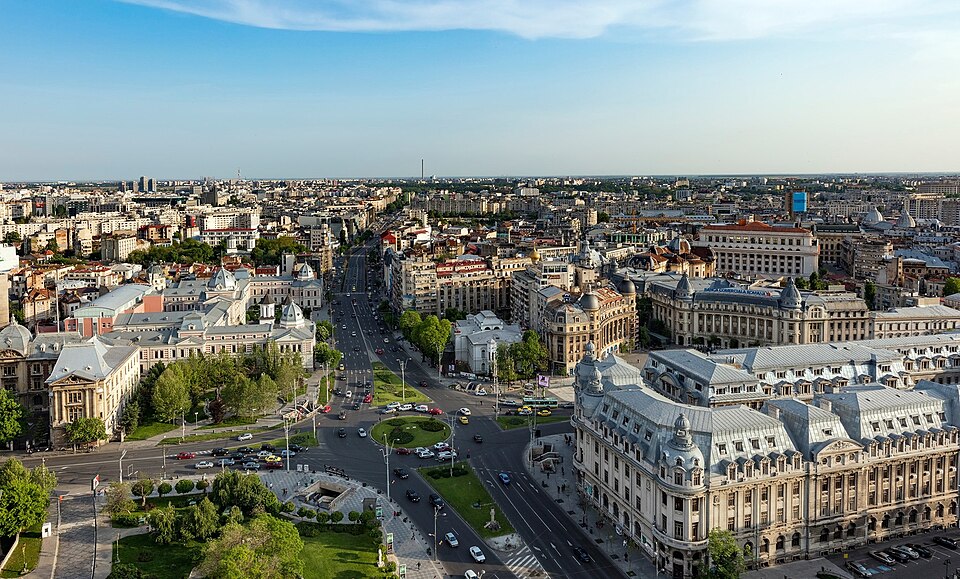
Welcome to Bucharest, the capital and largest city of Romania, standing on the River Dâmbovița in the south-east of the country. First mentioned in 1459, it became a centre of Wallachian commerce and government, and in 1862 the capital of the Romanian United Principalities. In the decades after the founding of the Romanian Kingdom in 1881, its cosmopolitan spirit and eclectic architecture earned it the nickname Paris of the East. Severely damaged in the Second World War, the city grew rapidly under socialist rule, and Nicolae Ceaușescu's building programme left a lasting mark. Let us discover its palaces, churches and parks.
Sights
Palace of the Parliament
Prepare to be amazed by the scale of the Palace of the Parliament, originally designed as the People's House. Ordered by Nicolae Ceaușescu, it was built over 13 years, from 1984 to 1997, by chief architect Anca Petrescu and a team of around 700 architects. It is the heaviest building in the world, weighing about 4 million tonnes, and the largest civilian administrative building anywhere. It rises 84 metres above ground and reaches 92 metres below it. Today it houses both chambers of the Romanian Parliament.
Romanian Athenaeum

Photo: Diego Delso · CC BY-SA 4.0 · Wikimedia Commons Here stands the Romanian Athenaeum, an ornate, domed, circular concert hall opened in 1888, the city's most prestigious venue and home of the George Enescu Philharmonic. Designed by the French architect Albert Galleron, it was partly paid for by a public fundraising campaign that lasted 28 years. Its slogan is still remembered: Donate one leu for the Athenaeum! In 1919 the building hosted the conference that ratified the union of Bessarabia, Transylvania and Bukovina with Romania.
Arcul de Triumf
On Kiseleff Road in northern Bucharest stands the Arcul de Triumf, commemorating Romania's victory in the First World War and the coronation of King Ferdinand and Queen Marie. The first arch on this site was a hurried wooden structure, built after independence in 1878 so that victorious troops could march beneath it. The present stone arch, designed by Petre Antonescu and closely modelled on the Arc de Triomphe in Paris, was inaugurated on 1 December 1936. Military parades still pass beneath it on 1 December.
Stavropoleos Monastery
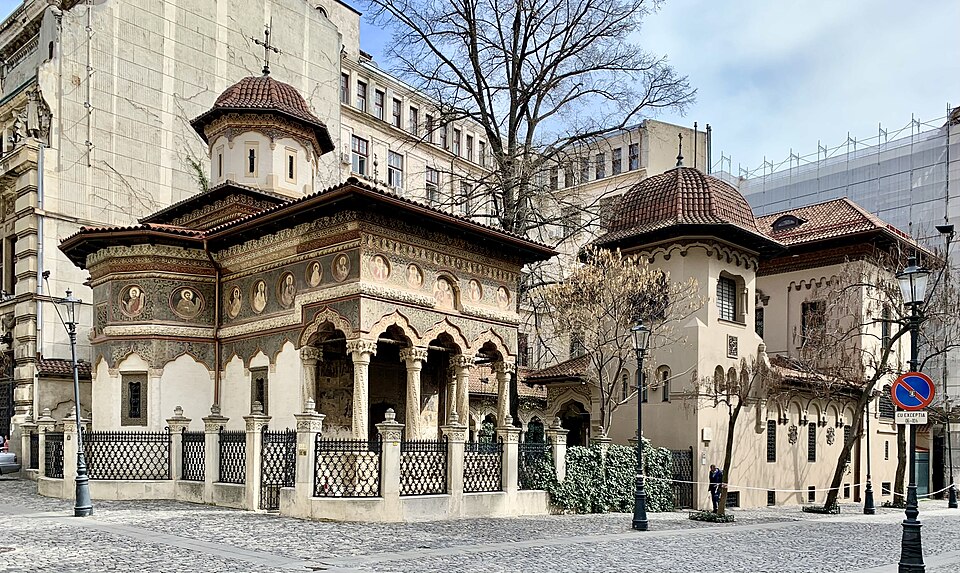
Photo: Neoclassicism Enthusiast · Public domain · Wikimedia Commons Tucked away in central Bucharest is the Stavropoleos Monastery, a small Orthodox convent for nuns. Its church, built in 1724 in the Brâncovenesc style, is dedicated to the Archangels Michael and Gabriel. It was founded by a Greek monk named Ioannikios, who supported the monastery with the income from his inn. The name means city of the Cross in Greek. Listen closely and you may hear its choir, as the monastery holds the largest collection of Byzantine music books in Romania.
Village Museum

Photo: Chainwit. · CC BY-SA 4.0 · Wikimedia Commons Step into the countryside without leaving the city at the Village Museum, an open-air ethnographic museum in King Michael I Park. Created by the sociologist Dimitrie Gusti and inaugurated on 10 May 1936, it was at the time only the fourth open-air museum in Europe. Wander among 123 authentic peasant settlements brought here from every corner of Romania, from Transylvania and Moldavia to Maramureș, with structures ranging from the 17th to the 20th century.
Herăstrău Park

Photo: Crislia · CC BY-SA 4.0 · Wikimedia Commons Finish your visit with a stroll in King Michael I Park, formerly known as Herăstrău Park, on the northern side of Bucharest around Lake Herăstrău. It covers about 187 hectares, 74 of them water, and small boats are allowed on the lake. The area was once full of marshes, drained in the early 1930s before the park opened in 1936. Its names tell a story of their own: it has been named after King Carol the Second and even after Stalin, whose statue was torn down in 1956.