 Sofa VoyageSuomeksi
Dublin

Welcome to Dublin, the capital and largest city of Ireland. It sits on Dublin Bay at the mouth of the River Liffey, with the Dublin Mountains rising to the south. The Gaels settled here during or before the 7th century, followed by the Vikings, and by the 12th century Dublin had become Ireland's principal settlement. After 1800 it was briefly the second-largest city in the British Empire, and after independence in 1922 it became the capital of the Irish Free State. Let's start our walk at the city's oldest university.
Sights
Trinity College Dublin
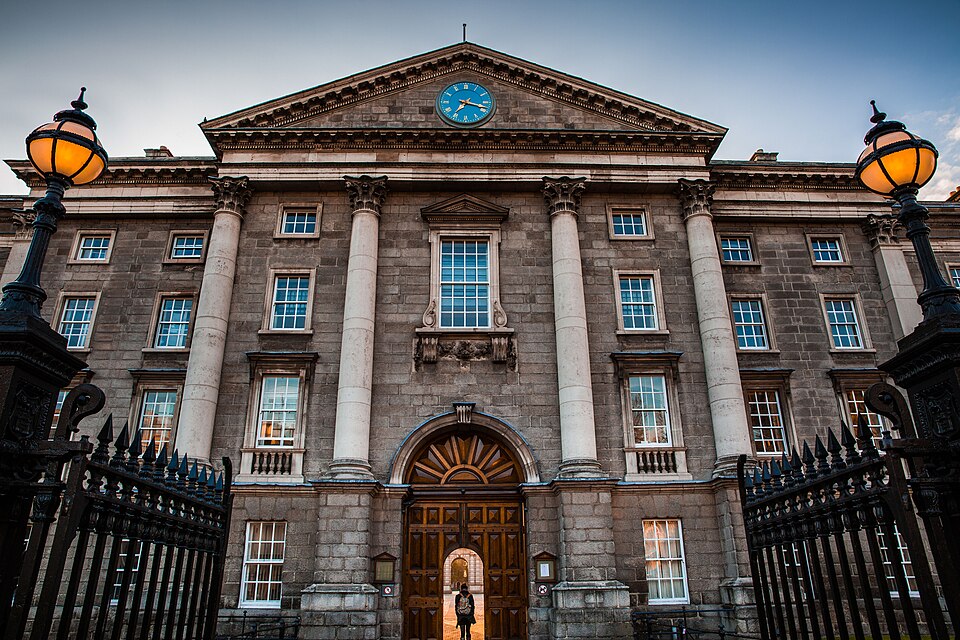
Photo: Stephen Bergin steve_ · CC0 · Wikimedia Commons Step through the gates of Trinity College Dublin, founded in 1592 by Queen Elizabeth the First. It is Ireland's oldest university and one of the seven ancient universities of Great Britain and Ireland. As you cross the grounds, look for landmarks like the Campanile. The great treasure here is in the library: since 1661 it has kept the Book of Kells, and it also holds the Trinity College harp and a copy of the Proclamation of the Irish Republic. More than two million visitors come to these grounds each year.
Guinness Storehouse

Photo: Steven Lek · CC BY-SA 4.0 · Wikimedia Commons Welcome to the Guinness Storehouse at St. James's Gate Brewery. The building dates from 1902, when it was built as a fermentation plant, the place where yeast was added to the brew, and it was the first multi-storey steel-framed building in Ireland. It worked as a fermentation plant until 1988. Inside, seven floors wrap around a glass atrium shaped like a pint of Guinness. Start with the four ingredients, water, barley, hops and yeast, and finish in the Gravity Bar at the top, with views over Dublin.
Dublin Castle

Photo: J.-H. Janßen · CC BY-SA 3.0 · Wikimedia Commons You are at Dublin Castle, for centuries the seat of English and later British government in Ireland. A castle has stood here since the days of King John, chosen for the highest point of central Dublin, though most of what you see today is a Georgian palace from the 18th century. In 1922 the complex was ceremonially handed over to the new Provisional Government led by Michael Collins. And here is a lovely detail: the castle stands by the dark pool, Dubh Linn in Irish, that gave Dublin its name.
St Patrick's Cathedral

Photo: Diliff · CC BY-SA 3.0 · Wikimedia Commons Before you rises St Patrick's Cathedral, the national cathedral of the Church of Ireland. Curiously, it is not the seat of a bishop: the Archbishop of Dublin has his seat at Christ Church Cathedral, only about 400 metres away. Since 1870 St Patrick's has served the whole of Ireland, drawing members of its chapter from all 12 dioceses of the Church of Ireland. The cathedral is led by a dean, an office that has existed since 1219, and its most famous dean was the writer Jonathan Swift.
Temple Bar
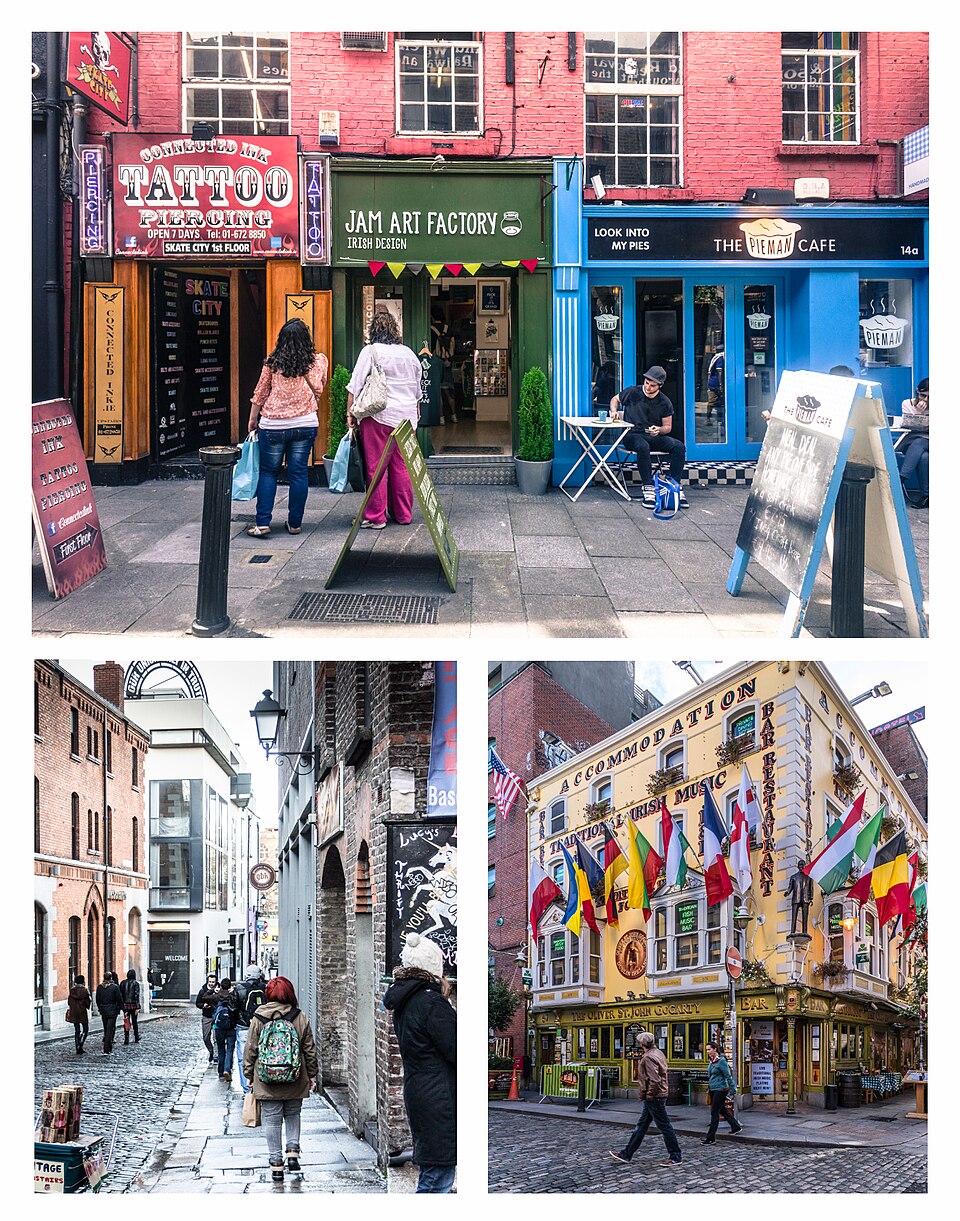
Photo: William Murphy · CC BY-SA 2.0 · Wikimedia Commons Welcome to Temple Bar, the lively district on the south bank of the Liffey, promoted as Dublin's cultural quarter and a centre of the city's nightlife. Its story goes back a long way. In medieval times an Augustinian friary stood here from around 1259, in a suburb outside the city walls. In the 17th century the land was redeveloped as gardens for wealthy families. Back then the Liffey's shoreline ran further inland than it does today, along the line of Essex Street, Temple Bar and Fleet Street.
Christ Church Cathedral
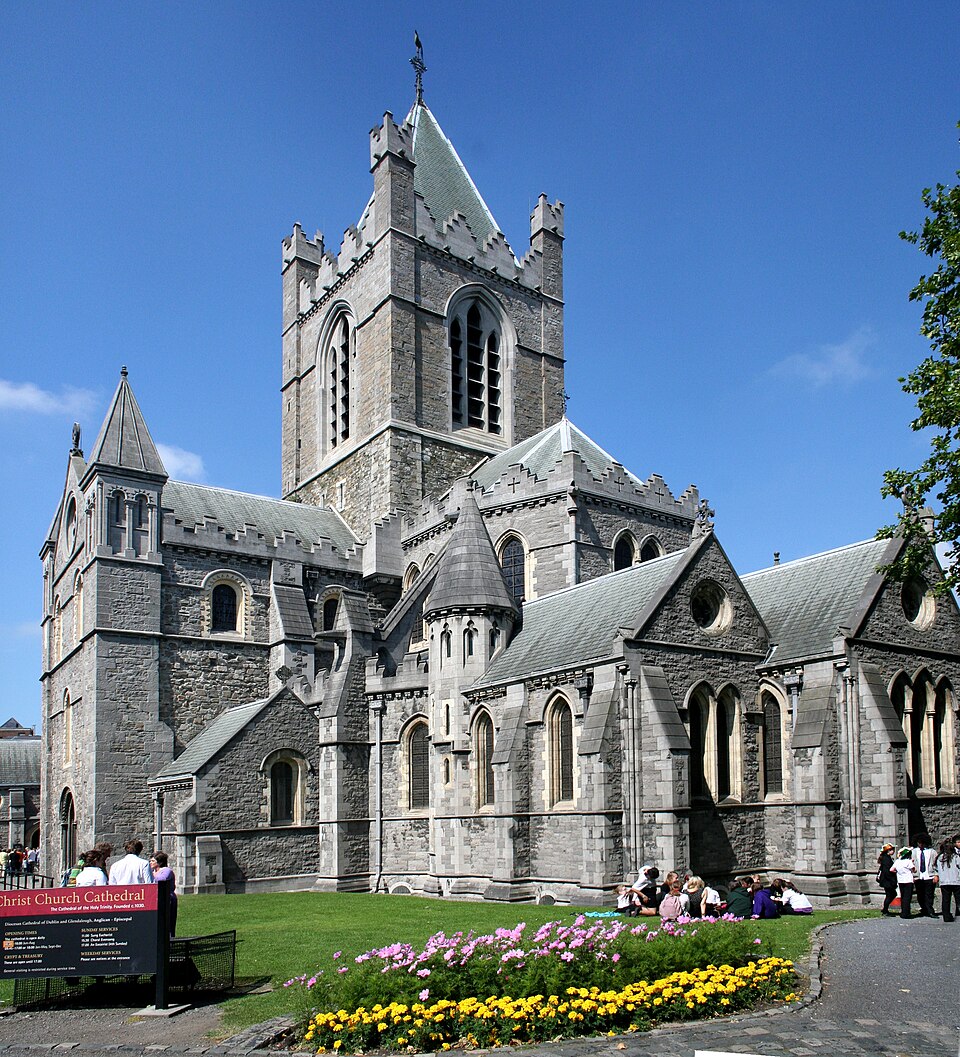
Photo: Ingo Mehling · CC BY-SA 4.0 · Wikimedia Commons Here stands Christ Church Cathedral, the elder of Dublin's two medieval cathedrals. It was founded in the early 11th century under the Viking king Sitric Silkenbeard, then rebuilt in stone in the late 12th century under the Norman lord Strongbow, using stone and craftsmen brought from Somerset. After a partial collapse in the 16th century, the building was extensively rebuilt in the late 19th century. That work gave it its present form, including the tower, the flying buttresses and the distinctive covered footbridge you can see.
Ha'penny Bridge
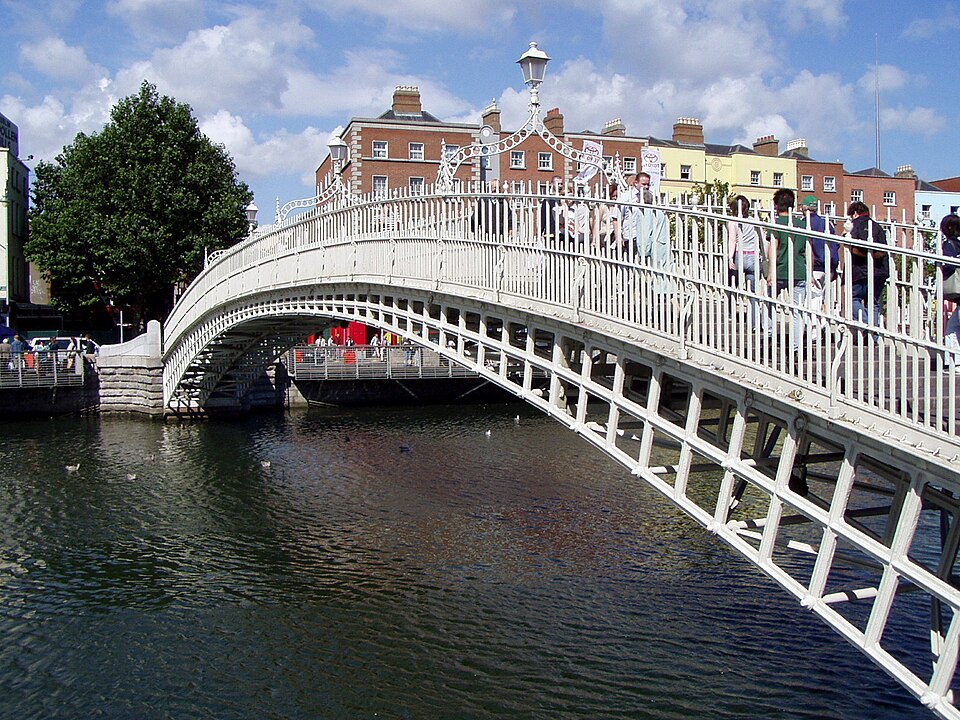
Photo: Public domain · Wikimedia Commons Let's finish on the Ha'penny Bridge, the graceful cast-iron footbridge over the Liffey, opened in May 1816. The iron was cast in Shropshire, in England. Before it existed, seven ferries run by William Walsh carried people across the river. When he was told to repair them or build a bridge, he chose the bridge, and won the right to charge a ha'penny toll from everyone crossing it for 100 years. First named after the Duke of Wellington, it is officially the Liffey Bridge, but Dubliners still call it the Ha'penny Bridge.