 Sofa VoyageSuomeksi
Jerusalem

Welcome to Jerusalem, set on a plateau in the Judaean Mountains between the Mediterranean and the Dead Sea. It is one of the oldest cities in the world, and it is holy to the three major Abrahamic religions: Judaism, Christianity and Islam. Both Israelis and Palestinians claim it as their capital, and its status lies at the heart of their conflict. Few places have lived through so much: over its long history, Jerusalem has been besieged 23 times and captured and recaptured 44 times. The walls built under Suleiman the Magnificent in the 16th century still define the Old City, and that is where our tour begins.
Sights
Western Wall
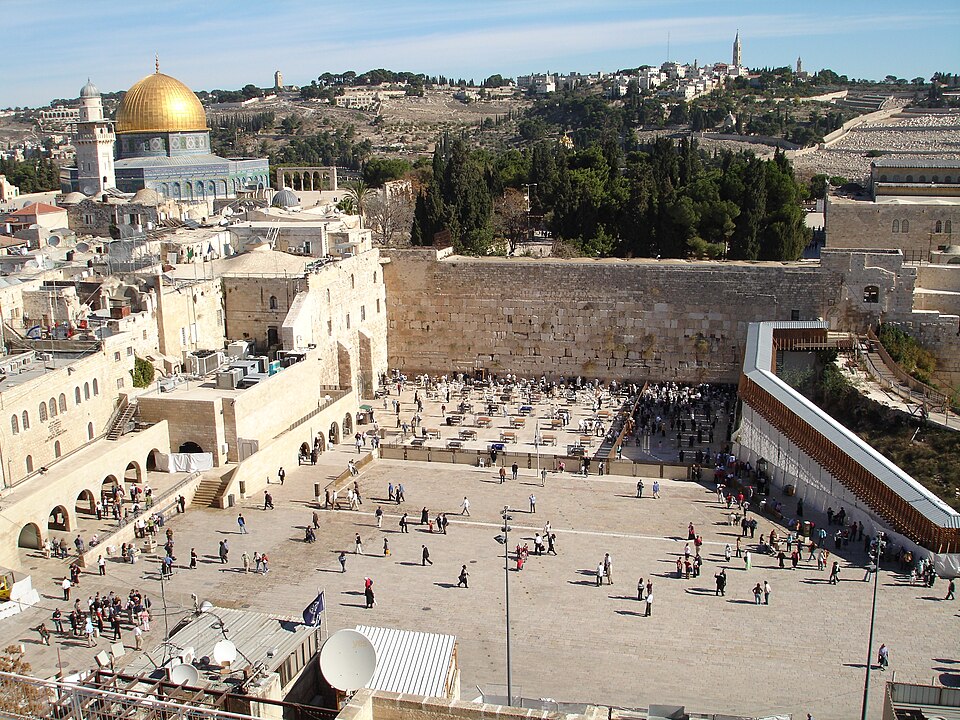
Photo: Golasso · CC BY-SA 4.0 · Wikimedia Commons You are standing before the Western Wall, an ancient retaining wall of the hill known to Jews and Christians as the Temple Mount. In the Islamic world it is called the Buraq Wall. Look closely at the stones: the very large blocks of the lower courses date from the time of Herod the Great, the medium-sized stones above them were added in the Umayyad period, and the smallest stones at the top are more recent, many from Ottoman times. For Jews, this is the holiest place where prayer is permitted, close to the presumed site of the Holy of Holies. Its whole length, much of it hidden behind buildings, is 488 metres.
Dome of the Rock
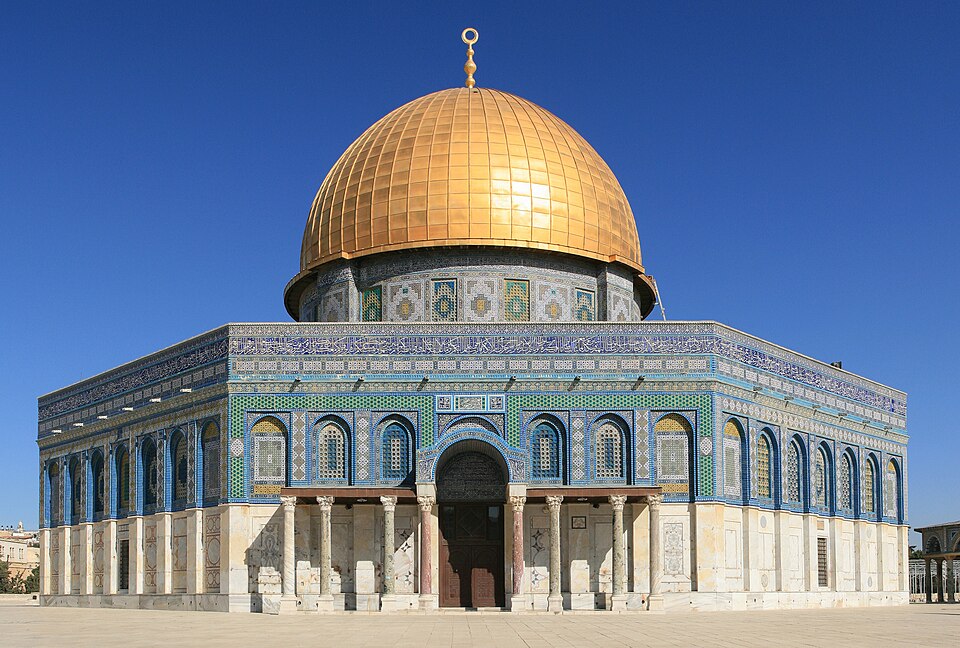
Photo: Ludvig14 · CC BY-SA 4.0 · Wikimedia Commons Its golden dome dominates Jerusalem's skyline. The Dome of the Rock, an octagonal shrine at the centre of the Al-Aqsa compound, was built by the Umayyad Caliphate on the orders of Abd al-Malik in 691 and 692, making it the world's oldest surviving work of Islamic architecture. It stands over the Foundation Stone. Muslims believe the Night Journey of Muhammad began from this rock, while in Jewish and Christian tradition it is linked to Abraham and to the site of the Temple. Its inscriptions are the earliest known proclaiming Islam and the Prophet. The bright blue-and-white tiles on the outside were added in the early Ottoman period.
Church of the Holy Sepulchre

Photo: Gerd Eichmann · CC BY-SA 4.0 · Wikimedia Commons Step inside the Church of the Holy Sepulchre, in the Christian Quarter, the holiest site in Christianity. According to tradition dating to the 4th century, it contains both Calvary, where Jesus was crucified, and the tomb where he was buried and rose again. The first church was built under Constantine the Great, destroyed in 1009 and rebuilt by 1048. Today the tomb itself is enclosed in a 19th-century shrine called the Aedicule. Here is a remarkable detail: control of the church is shared among several denominations, including Catholic, Greek Orthodox, Armenian, Coptic, Syriac and Ethiopian, under an understanding called the Status Quo, dating to 1757.
Old City of Jerusalem

Photo: Edmund Gall · CC BY-SA 2.0 · Wikimedia Commons Inside these walls lies the Old City, less than one square kilometre in area, yet home to sites of key importance to Judaism, Christianity and Islam. The walls and gates you see were built by the Ottomans between 1535 and 1542 under Suleiman the Magnificent. The Old City is divided into four uneven quarters, Muslim, Christian, Armenian and Jewish, a tradition that may have begun with a British map of the 1840s. Surprisingly, the Old City is not where Jerusalem began: most archaeologists place the original settlement at the City of David, on a rocky spur south of the Temple Mount. The Old City has been a UNESCO World Heritage Site since 1981.
Al-Aqsa Mosque

Photo: Godot13 · CC BY-SA 4.0 · Wikimedia Commons On the southern side of the compound stands the Al-Aqsa Mosque, also called the Qibli Mosque, the main prayer hall of the Al-Aqsa compound. According to Islamic tradition, a small prayer hall was first built here by Umar, the second caliph. The mosque was built by the Umayyad caliphs, on the same axis as the Dome of the Rock, and it has had a turbulent history: earthquakes destroyed it in 746 and again in 1033. The building today preserves the outline of the 11th-century rebuilding by the Fatimid caliph al-Zahir. After the Crusaders captured Jerusalem in 1099, it became a palace and the headquarters of the Knights Templar, until Saladin restored it as a mosque in 1187.
Mount of Olives
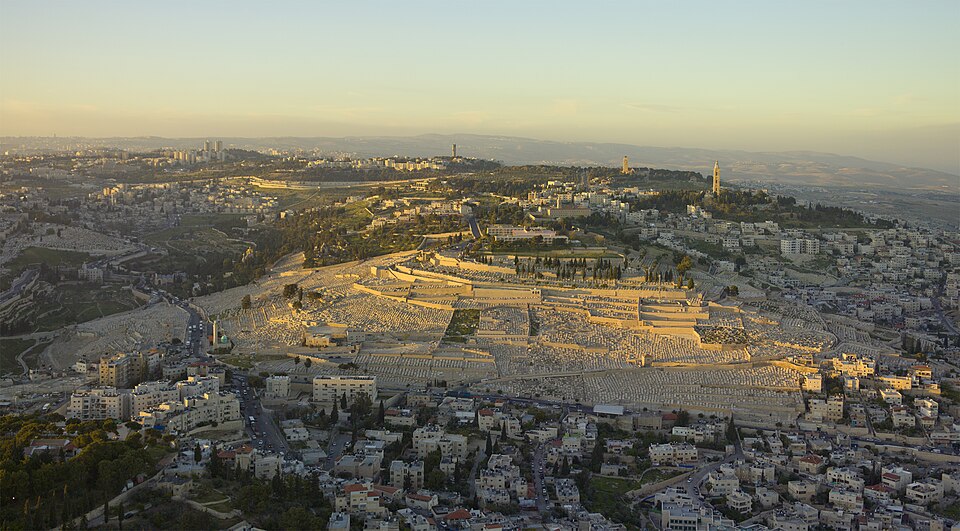
Photo: Godot13 · CC BY-SA 4.0 · Wikimedia Commons East of the Old City rises the Mount of Olives, named for the olive groves that once covered its slopes. Its western side, facing Jerusalem, has been used as a Jewish cemetery for over 3,000 years and holds around 150,000 graves. For Christians, the mountain is linked to several key events in the life of Jesus, and in the Acts of the Apostles it is the place from which he ascended to heaven. It has been a place of Christian worship since ancient times.
Tower of David
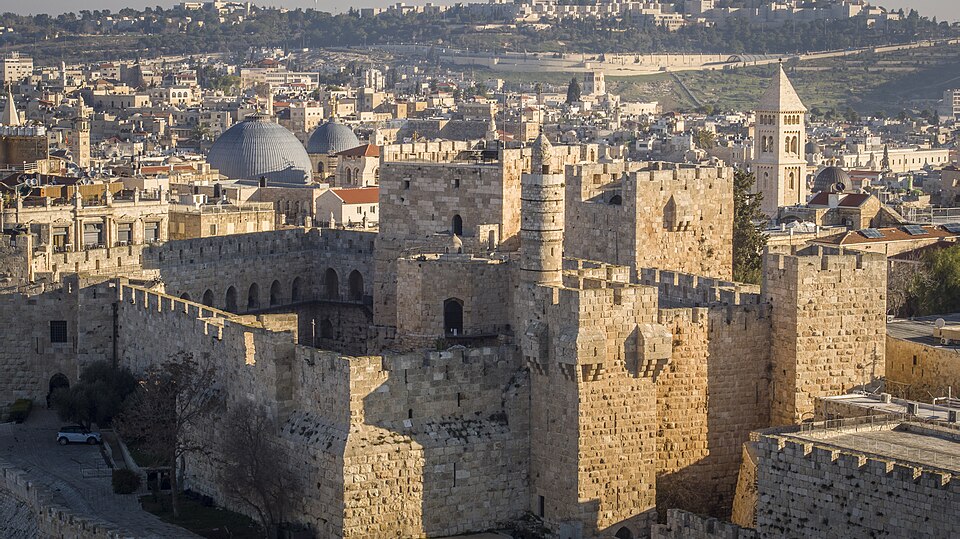
Photo: אורי אלוני · CC BY-SA 4.0 · Wikimedia Commons Near the Jaffa Gate rises the Tower of David, an ancient citadel that is also a museum. The fortress you see dates to the Mamluk and Ottoman periods, but it stands on a series of much older fortifications, Hasmonean, Herodian, Byzantine and Early Muslim. Here is a twist of history: the name Tower of David first referred to a massive Herodian tower, but in the 19th century it was also applied to a 17th-century minaret on the opposite side, and since 1967 it officially means the whole citadel. Today the citadel hosts concerts, craft shows and sound-and-light performances.
Yad Vashem
Photo: Unknown author Unknown author · Public domain · Wikimedia Commons On the Mount of Remembrance, on the western slope of Mount Herzl, lies Yad Vashem, Israel's official memorial to the victims of the Holocaust. Its name means a memorial and a name. Established in 1953, it combines research institutes, archives and a library with museums and memorials such as the Children's Memorial and the Hall of Remembrance. One of its founding goals was to honour non-Jews who, at personal risk, saved Jews during the Holocaust. Those recognised as Righteous Among the Nations are remembered here in the Garden and the Avenue of the Righteous. Take a quiet moment as you walk.