 Sofa VoyageSuomeksi
Kinshasa

Welcome to Kinshasa, the capital and largest city of the Democratic Republic of the Congo. It stretches along the southern shores of the Pool Malebo on the Congo River, and right across the water lies Brazzaville, capital of the Republic of the Congo, making the two the closest pair of capital cities in the world. From 1881 to 1966 the city was called Léopoldville, before being renamed after the old village of Nshasa. Kinshasa is one of the world's fastest-growing megacities and the largest nominally French-speaking city on Earth, though Lingala rules the street. Let us begin.
Sights
Our Lady of the Congo Cathedral

Photo: unknown, Actualités Africaines · Public domain · Wikimedia Commons On Liberation Avenue stands Our Lady of the Congo Cathedral, also known simply as Kinshasa Cathedral. This massive church was built in 1947, when the country was still the Belgian Congo under colonial rule. During the Mobutu era it was also called the Cathedral of Our Lady of Lingwala, after the district where it stands. It serves as the seat of the Metropolitan Archdiocese of Kinshasa, created in 1959 by Pope John the Twenty-Third.
Kinshasa Botanical Garden
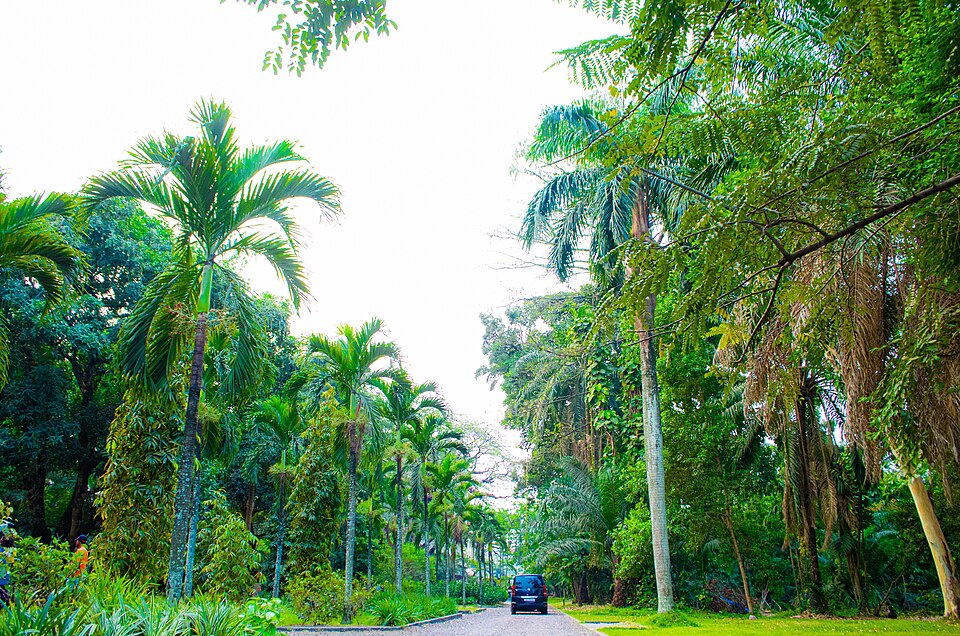
Photo: Leon Bilili · CC BY-SA 4.0 · Wikimedia Commons In the Gombe district, opposite the city zoo, lies the Kinshasa Botanical Garden, established in 1933. Over the years it has carried other names, including Fernand De Boeck Park and, from 1970 to 1978, the Park of the Revolution. It covers about 8 hectares and is used for both science and education, holding 286 plant species. Wander through its arboretum, devoted to native flora, with more than 100 kinds of trees, or past its nursery, seed bank and herbarium.
Lola ya Bonobo

Photo: Vanessawoods · Public domain · Wikimedia Commons South of Kimwenza, at the little waterfalls of the Lukaya, lies Lola ya Bonobo, the world's only sanctuary for orphaned bonobos. Its name means heaven for bonobos in Lingala. It was founded by Claudine André in 1994, and about 60 bonobos live here in 30 hectares of primary forest. Most arrive as young infants rescued from the bushmeat and pet trade, and are first cared for by a substitute human mother before joining a group. Living almost as in the wild, they show all the natural behaviours of wild bonobos, and some, such as tool use, never seen in the wild.
National Museum of the Democratic Republic of the Congo
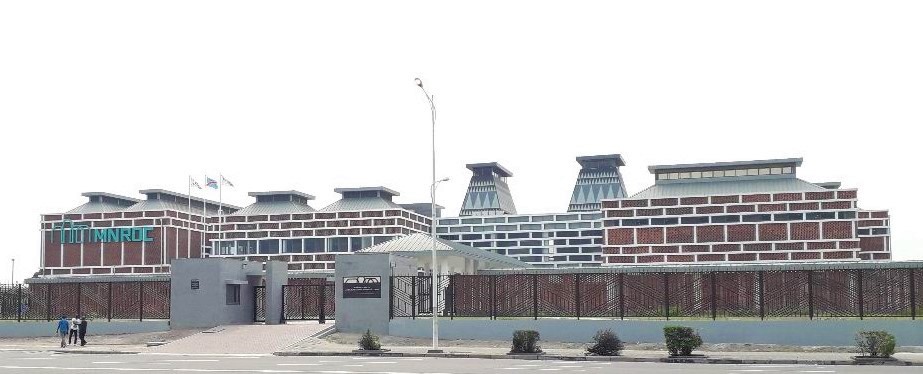
Photo: Munfarid1 · CC BY-SA 4.0 · Wikimedia Commons Step into the National Museum of the Democratic Republic of the Congo, devoted to the cultural history of the country's many peoples and historical eras. The building was funded by the Korea International Cooperation Agency and built over 33 months by Congolese and South Korean experts, using local materials, solar energy and natural air circulation. It opened to the public on 23 November 2019. Its three exhibition halls cover 6,000 square metres and can present 12,000 objects in their cultural context.
Palais du Peuple
Here stands the Palais du Peuple, the People's Palace, seat of the National Assembly and the Senate. It was commissioned by President Mobutu Sese Seko after his visit to China in 1973, and built with Chinese cooperation and an interest-free line of credit between 1975 and 1979. Its architecture was inspired by the Great Hall of the People in Beijing. The complex also includes the Martyrs' Stadium, a large football venue built by China in 1994.
Limete Tower
In the commune of Limete rises the Limete Tower, also called the Tower of the National Heroes of Congo. It was meant as a monument to Patrice Lumumba, at the crossroads on the boulevard that Mobutu renamed after him in 1966. The foundation stone was laid by Julius Nyerere, president of Tanzania, on 24 November 1967. The tower was designed by the French-Tunisian architect Olivier-Clément Cacoub, with four cylindrical concrete columns and a planned copper spire, but construction stopped by 1974 at 12 floors, and it stood unfinished for many years.