 Sofa VoyageSuomeksi
Minsk

Welcome to Minsk, the capital and largest city of Belarus, built on the Svislach river and on the Nyamiha, which now flows underground. Minsk was first mentioned in 1067 and became the capital of a small principality before passing to the Grand Duchy of Lithuania in 1242. It received town privileges in 1499 and later belonged to the Polish-Lithuanian Commonwealth and then the Russian Empire. From 1919 it was the capital of the Byelorussian Soviet Republic, and after the Soviet Union dissolved, it became the capital of independent Belarus. Let us set off, from a geometric library to castles in the countryside.
Sights
National Library of Belarus
Before you stands one of the most unusual buildings in Minsk, the National Library of Belarus. Its main structure has the shape of a rhombicuboctahedron, a geometric solid with many faces. The building is 73.6 metres tall, has 23 floors and weighs 115,000 tonnes, not counting the books. Construction started in 2002, and the new library opened on 16 June 2006. It is the largest library in Belarus, with room for about 2,000 readers, and holds the largest collection of Belarusian printed materials.
Independence Square
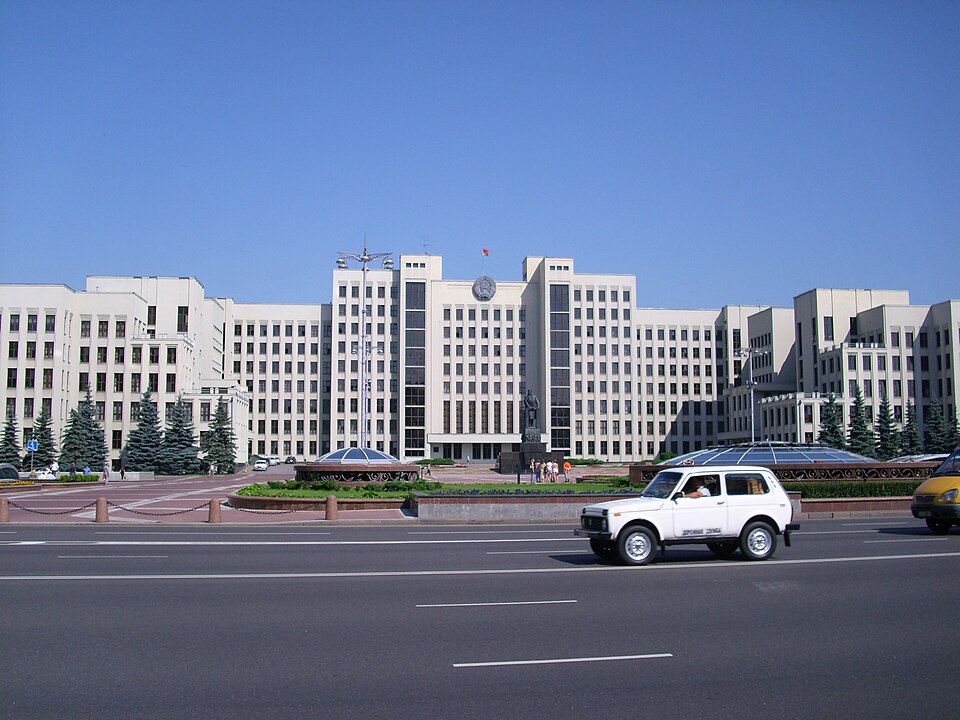
Photo: Cédric Lafont · CC BY-SA 3.0 · Wikimedia Commons You are now on Independence Square, one of the largest squares in Europe and a landmark on Independence Avenue. The National Assembly of Belarus and Minsk City Hall both stand here. In Soviet times it was called Lenin Square. It was designed by Iosif Langbard as the city's main ceremonial venue for rallies. During the Second World War most of the buildings on the square were destroyed. After the fall of the Soviet Union, a reconstruction began, with its first stage completed in 2002.
Holy Spirit Cathedral
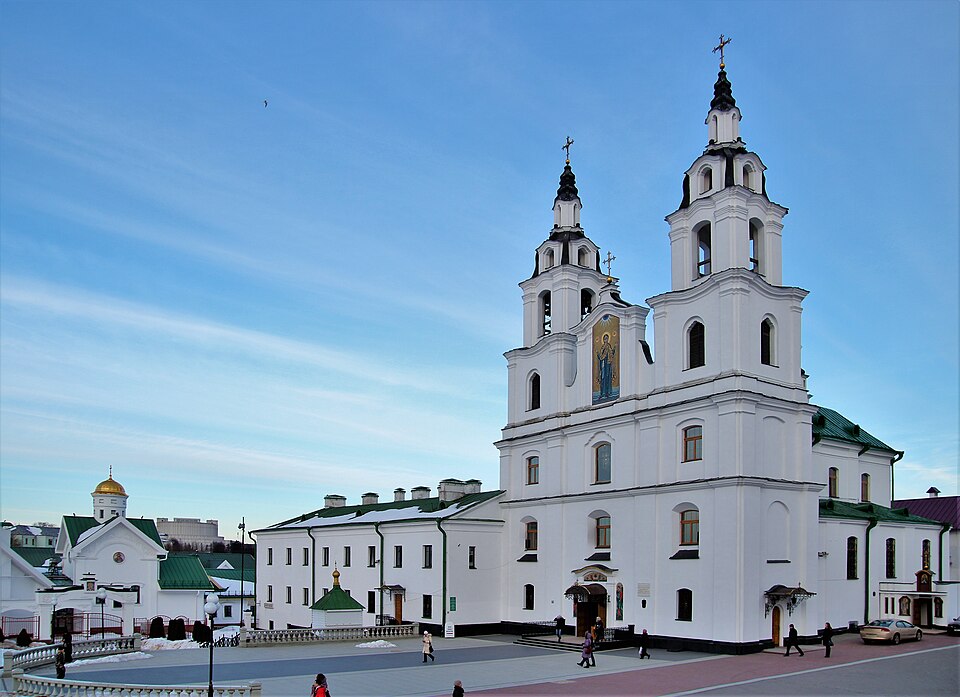
Photo: Insider · CC BY-SA 3.0 · Wikimedia Commons In the Upper City stands the Holy Spirit Cathedral, the mother church of the Belarusian Orthodox Church. It was built between 1633 and 1642 as part of a Bernardine monastery, on a spot where Orthodox monasteries had stood before. The site became Orthodox again in 1860. Before 1596 a monastery dedicated to Saints Cosmas and Damian stood here, which also served as a defence on the eastern edge of old Minsk. The cathedral is now one of the main landmarks of the city and a listed part of Belarusian cultural heritage.
Trinity Suburb
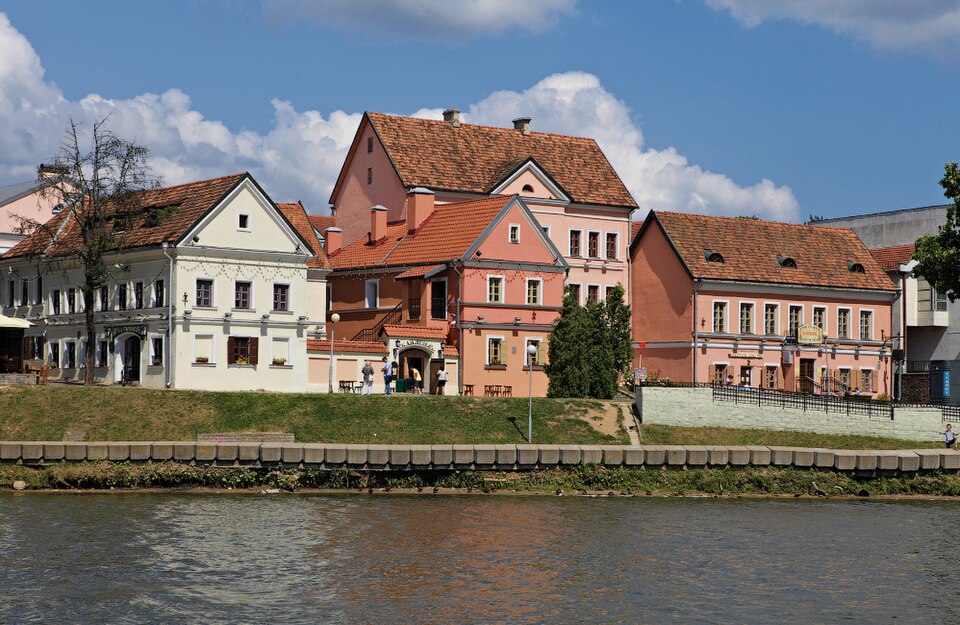
Photo: Андрэй Дзмiтрыеў ( http://fgb.by/viewtopic.php?p=60515#60515 ) · CC BY-SA 3.0 · Wikimedia Commons Stroll along the left bank of the Svislach into the Trinity Suburb, once the trade and administrative heart of Minsk. The first Catholic church in Minsk stood here, and the name most likely comes from the Church of the Trinity, founded by Jogaila in 1390. Today it is one of the favourite places of locals and visitors alike. Nearby rise the National Opera and Ballet Theatre and the Island of Tears, a memorial to Soviet soldiers who died in the Afghanistan war. The suburb even appears on the 5-ruble banknote of the 2000 series.
Mir Castle Complex
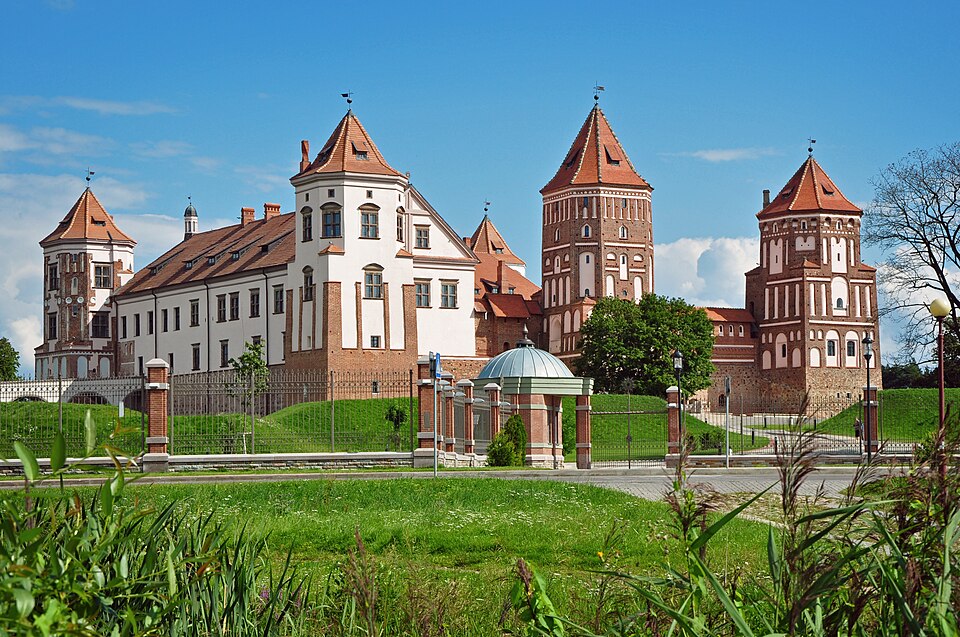
Photo: Вадзім Новикаў · CC BY-SA 3.0 · Wikimedia Commons Travelling out of the capital, we reach the Mir Castle Complex, a fortified castle and UNESCO World Heritage Site in the town of Mir. It was built in the 16th century in the late Brick Gothic style, and it is one of the few surviving architectural monuments of the Polish-Lithuanian Commonwealth in today's Belarus. Duke Juryj Illinič began building it, with five towers around a courtyard whose walls formed a square 75 metres on each side. In 1568 it passed to Mikalaj Radziwil, nicknamed the Orphan, who added a stately three-storey residence along its inner walls.
Nesvizh Castle
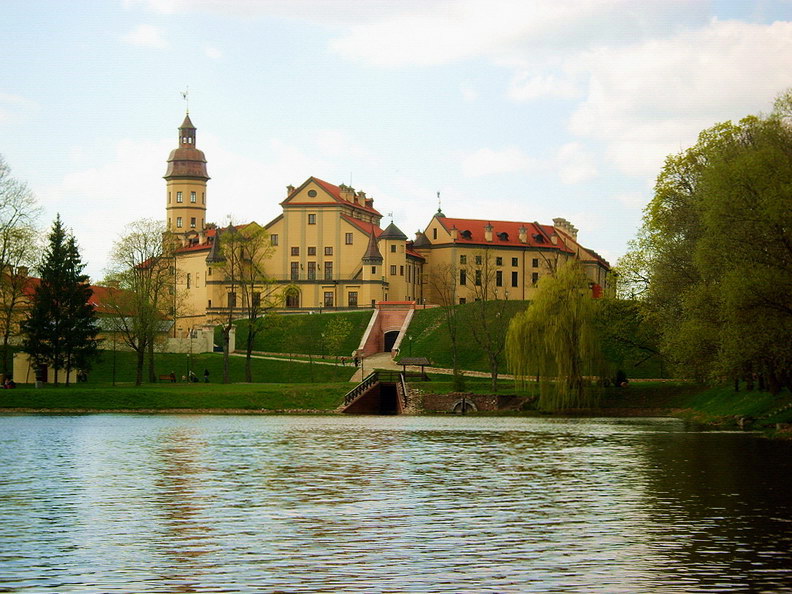
Photo: Сяргей Кончар ( https://fgb.by/viewtopic.php?p=48709&highlight=#48709 ) · CC BY-SA 3.0 · Wikimedia Commons About 29 kilometres from Mir stands Nesvizh Castle, the residence of the powerful Radziwiłł family, who owned the estate from 1533. Built in the 16th and 17th centuries, it has been sacked, damaged and abandoned many times, and was even used as a storehouse. In 2005, the castle, its church and surroundings were inscribed on the UNESCO World Heritage List. Together with the nearby Corpus Christi Church, it played a key role in the development of Central European and Russian architecture. Because the Radziwiłłs were so wealthy and important, the Lithuanian Metrica, the state archives, was moved here in 1551.