 Sofa VoyageSuomeksi
Reykjavík
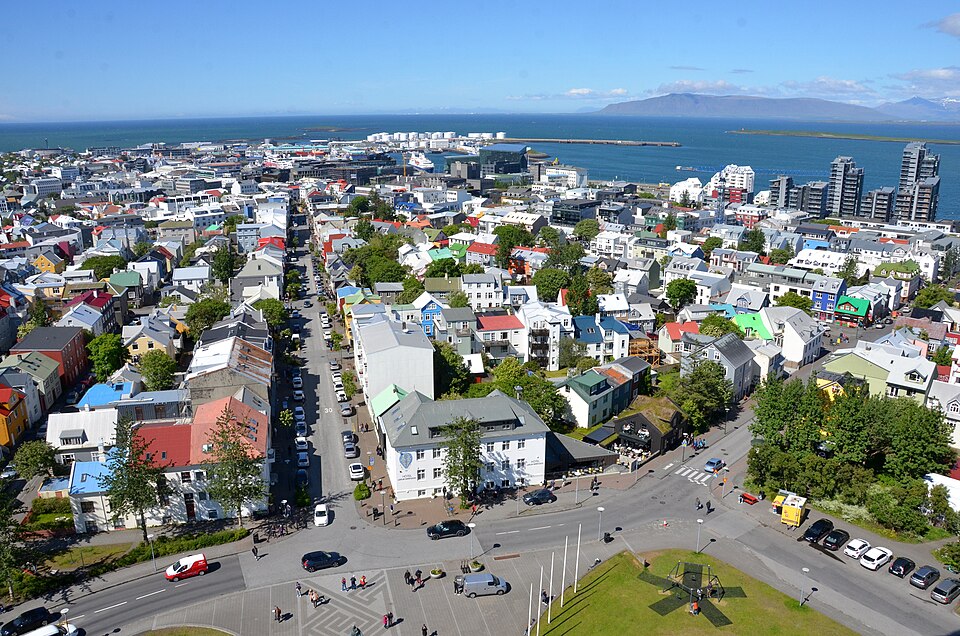
Welcome to Reykjavík, the capital and largest city of Iceland. It lies on the southern shore of Faxaflói bay in the southwest of the island, and at a latitude of 64 degrees north it is the world's northernmost capital of a sovereign state. According to the old Book of Settlements, the settlement of Iceland began right here when Ingólfur Arnarson arrived from Norway in 874. Yet for over 900 years there was no town at all; Reykjavík was officially founded as a trading town only in 1786. Let's explore.
Sights
Hallgrímskirkja
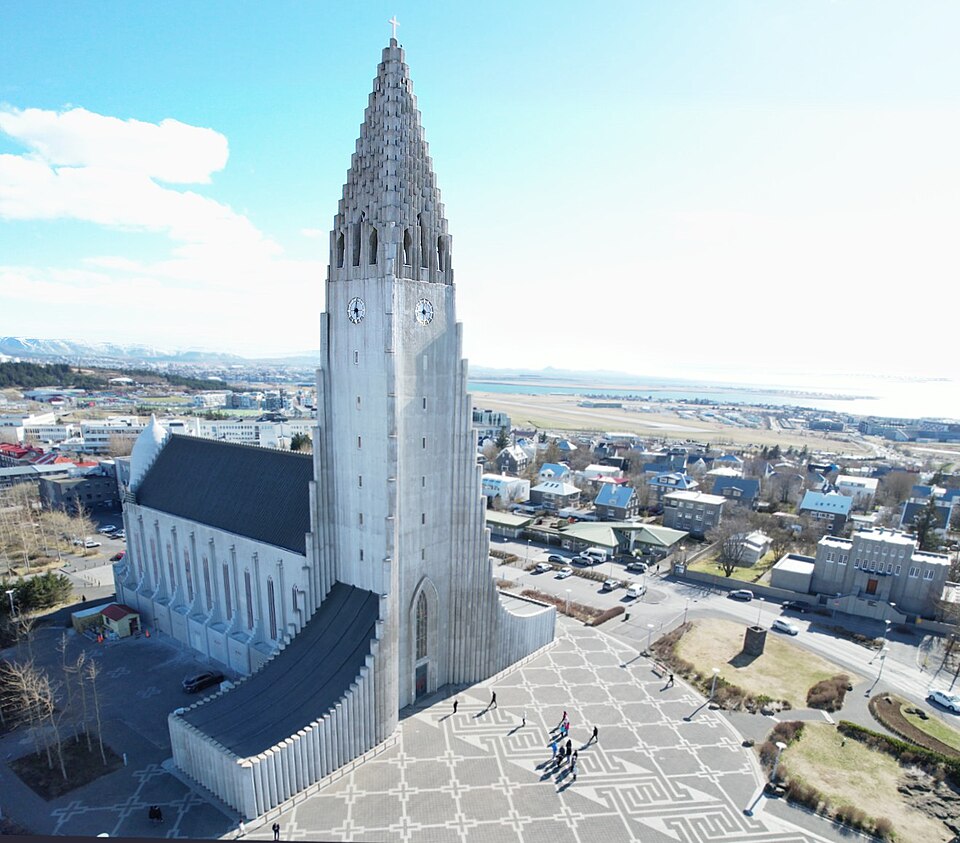
Photo: Steinninn · CC BY 4.0 · Wikimedia Commons Towering over the city from the hilltop of Skólavörðuholt is Hallgrímskirkja, visible from almost everywhere in Reykjavík. At 74.5 metres, it is the largest church in Iceland and the country's second tallest building. Its architect, Guðjón Samúelsson, is said to have drawn inspiration from Iceland's landscape, in particular the columnar basalt formations that look like organ pipes. Look for that idea in its distinctively curved spire and side wings. The church is named after the poet and cleric Hallgrímur Pétursson, author of the Passion Hymns.
Harpa
In the Austurhöfn area sparkles Harpa, Reykjavík's concert hall and conference centre. Its glass facade is made of geometric panels in different colours, inspired by Iceland's basalt landscape, and it was designed by Henning Larsen Architects together with the artist Olafur Eliasson. Construction began in 2007, but the financial crisis brought it to a halt, until the government decided to fund the rest of the half-built hall. For several years it was the only construction project in Iceland. The opening concert was held on 4 May 2011.
Blue Lagoon
Out on the Reykjanes Peninsula, in the middle of a lava field, lies the Blue Lagoon, one of the most visited attractions in Iceland. The water actually comes from the nearby Svartsengi geothermal power station. Its milky blue colour comes from silica, which also forms the soft white mud on the bottom that bathers rub onto their skin. The water is rich in salts and algae, and in the bathing area it averages a cosy 37 to 39 degrees. It lies only about 20 kilometres from Keflavík International Airport.
Perlan
On top of Öskjuhlíð hill gleams Perlan, the Pearl, a glass dome resting on six hot water tanks for the city's district heating. Four of the tanks still do that job, while one holds an ice cave and another a planetarium. Today Perlan is a natural history museum. Walk through the 100-metre ice cave, built from around 400 tonnes of ice, snow and ash, watch a Northern Lights show in the planetarium, and then step out onto the observation deck for a 360 degree view of Reykjavík.
Sun Voyager
Along the seafront by Sæbraut road stands the Sun Voyager, a gleaming stainless steel sculpture by Jón Gunnar Árnason. It is described as a dreamboat, an ode to the Sun, and the artist meant it to convey the promise of undiscovered territory and a dream of hope, progress and freedom. It won a competition held in 1986 to mark the city's 200th anniversary, and the full-sized work was unveiled on Reykjavík's birthday, 18 August 1990.
Þingvellir
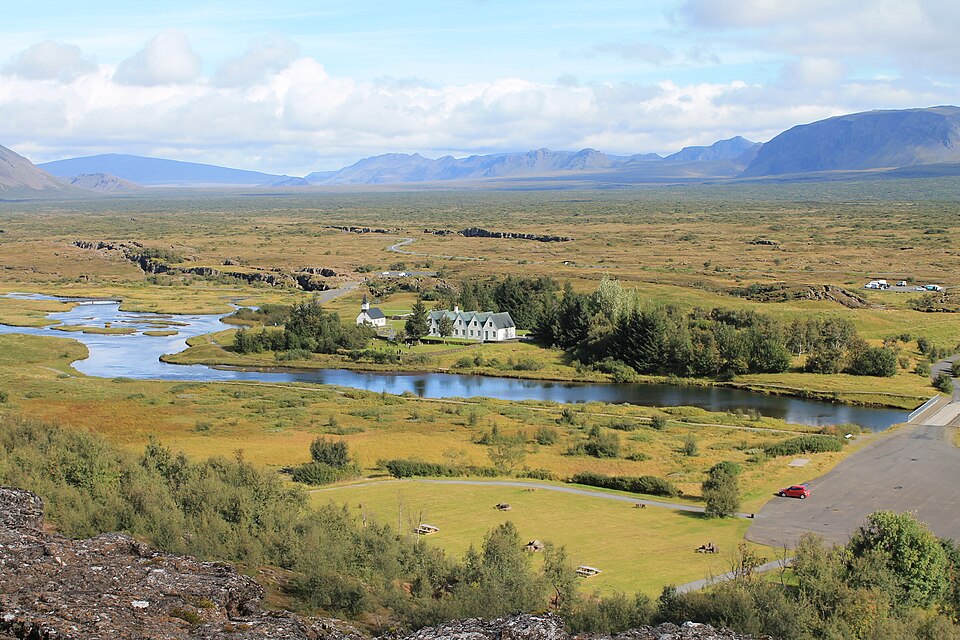
Photo: Ivan Sabljak · CC BY-SA 3.0 · Wikimedia Commons About 40 kilometres northeast of Reykjavík lies Thingvellir, one of the most important places in Iceland's history. From 930 until 1798, the Althing, Iceland's parliament, gathered here in the open air every year. The landscape is just as remarkable: the valley is a rift marking the boundary between the North American and Eurasian tectonic plates, so you are standing on the crest of the Mid-Atlantic Ridge. To the south shines Þingvallavatn, Iceland's largest natural lake. The national park was founded in 1930 and became a World Heritage Site in 2004.