 Sofa VoyageSuomeksi
Riga
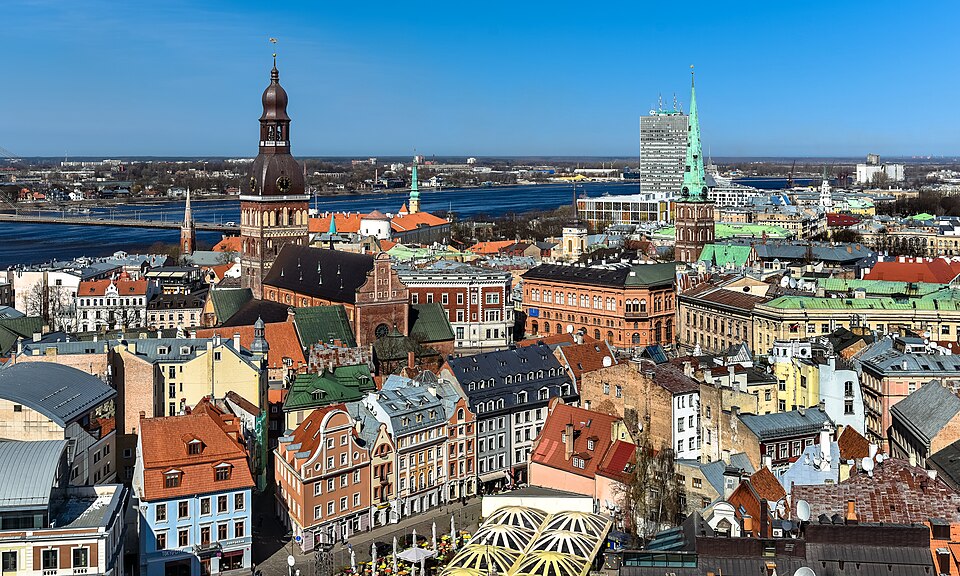
Welcome to Riga, the capital and largest city of Latvia, home to about a third of the country's people. The city lies on the Gulf of Riga, at the mouth of the Daugava river where it meets the Baltic Sea. Founded in 1201, Riga was a member of the Hanseatic League, and its historic centre is a UNESCO World Heritage Site, famous for its Art Nouveau buildings and 19th century wooden architecture. In 2014 it was a European Capital of Culture. Let's start in the heart of the old town.
Sights
House of the Blackheads

Photo: Diliff · CC BY-SA 3.0 · Wikimedia Commons In front of you is the House of the Blackheads, with its richly decorated Mannerist facade. It was first built in 1334 as a meeting and celebration place for merchants, and from the 15th century it was used by the Brotherhood of Blackheads, a guild of unmarried merchants, shipowners and foreigners. It is said to be the site of the first decorated Christmas tree, put up in 1510. Bombed to ruins in 1941 and demolished in 1948, it was rebuilt at the end of the 1990s, partly funded by more than 5,000 people who each paid to place a brick in the wall.
Riga Cathedral

Photo: Zairon · CC BY-SA 4.0 · Wikimedia Commons Here stands Riga Cathedral, the Lutheran Cathedral Church of Saint Mary and one of the most recognisable landmarks in Latvia. Bishop Albert of Riga, who came from Lower Saxony, began it near the Daugava in 1211, and it is considered the largest medieval church in the Baltic states. Look up at the weathercock, a feature of all the city's oldest churches. Locals often call it the Dome Cathedral, which is a little redundant, since Dom is simply the German word for cathedral.
St. Peter's Church

Photo: Diliff · CC BY-SA 3.0 · Wikimedia Commons Before you rises St. Peter's Church, dedicated to Saint Peter and today a Lutheran parish church. It is first mentioned in records from 1209, and because it was built of masonry it came through a great city fire that year undamaged. Its history spans three building periods, from the Romanesque and Gothic to the early Baroque. In 1408 a master builder from Rostock began a new sanctuary modelled on St. Mary's Church in his home city, though war delayed its completion.
Freedom Monument

Photo: Virtual-Pano · CC BY-SA 4.0 · Wikimedia Commons This is the Freedom Monument, honouring the soldiers who fell in the Latvian War of Independence. Unveiled in 1935 and paid for by private donations, it rises 42 metres in granite, travertine and copper. At the top, the copper figure of Liberty lifts three gilded stars, and locals fondly call her Milda. During the Soviet era the monument was considered for demolition but survived, and in 1987 about 5,000 people gathered here to lay flowers, a rally that renewed Latvia's independence movement. Please take a quiet moment here.
Riga Central Market

Photo: David Holt uploaded and derivative work: MrPanyGoff · CC BY-SA 2.0 · Wikimedia Commons Welcome to Riga Central Market, described as Europe's largest market and bazaar. Built between 1924 and 1930, it is one of the most notable 20th century structures in Latvia. Here is the surprising part: its five great pavilions were made by reusing old German Zeppelin hangars, finished in Neoclassical and Art Deco styles. With more than 3,000 trading stands spread over 72,300 square metres, it shares UNESCO World Heritage status with Old Riga.
Riga Castle

Photo: Diego Delso · CC BY-SA 3.0 · Wikimedia Commons On the banks of the Daugava stands Riga Castle, the official residence of the President of Latvia and home to several museums. It was founded in 1330 by the Livonian Order, after the people of Riga had rebelled and torn down the Order's earlier castle in the town centre. Rather than rebuild in the middle of a hostile city, the Order chose a site just outside the town walls. The castle was thoroughly rebuilt between 1497 and 1515, and the Swedes added spacious annexes in 1641.