 Sofa VoyageSuomeksi
Santiago

Welcome to Santiago, the capital and largest city of Chile, set in the Central Valley between the Andes to the east and the Coastal Range to the west. People have lived in this basin since at least the 10th millennium BC. The Spanish conquistador Pedro de Valdivia founded the colonial city on 12 February 1541, laying out a grid around the main square. Santiago survived floods, attacks and devastating earthquakes to become the political and economic heart of the country. Its landscape mixes colonial churches and a neoclassical core with modern towers and green hills. Let's start in the old centre.
Sights
Plaza de Armas
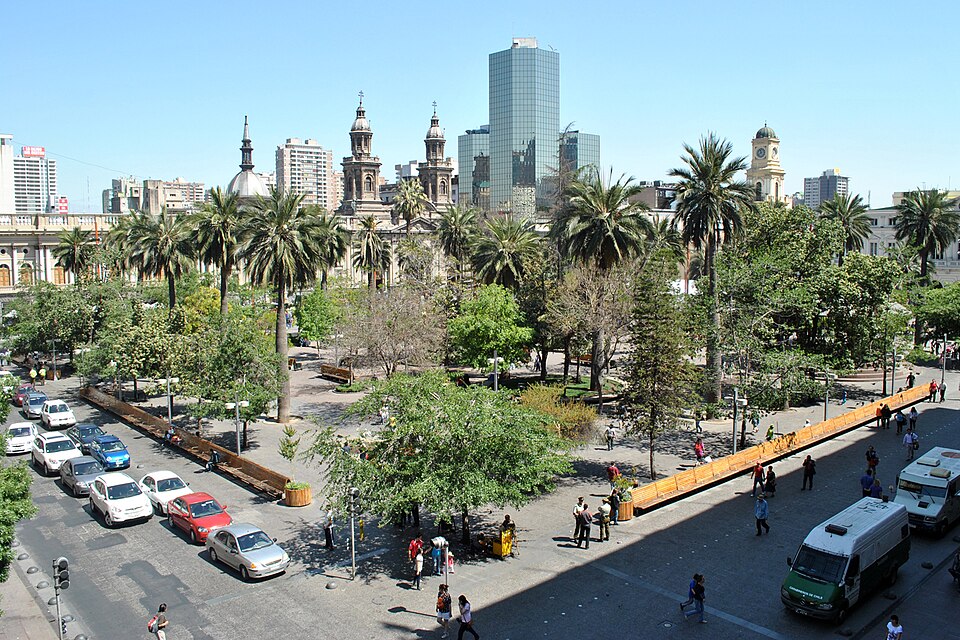
Photo: Apincheira · CC BY-SA 3.0 · Wikimedia Commons Here is where Santiago began: the Plaza de Armas, the city's main square. Valdivia laid out the colonial grid around it in 1541, back when it was the Plaza Mayor. Look around at the historic buildings framing it, including the Metropolitan Cathedral, the Central Post Office, the Palacio de la Real Audiencia, and the seat of local government, once home to the colonial Cabildo. A few steps away is the Museo Chileno de Arte Precolombino. The square and its surroundings were declared a national monument in 1986.
La Moneda Palace
Photo: Miguel hernandez · CC BY-SA 2.0 · Wikimedia Commons Before you stands La Moneda, the seat of the President of Chile, filling an entire block in the Civic District. Its name means the Mint, and that is exactly what it was built as. The Italian architect Joaquín Toesca designed it, and it opened in 1805. Coins were made here from 1814 until 1929. In 1845, under President Manuel Bulnes, the building became the seat of government and the presidential residence. Presidents no longer live here, but they still work here.
San Cristóbal Hill
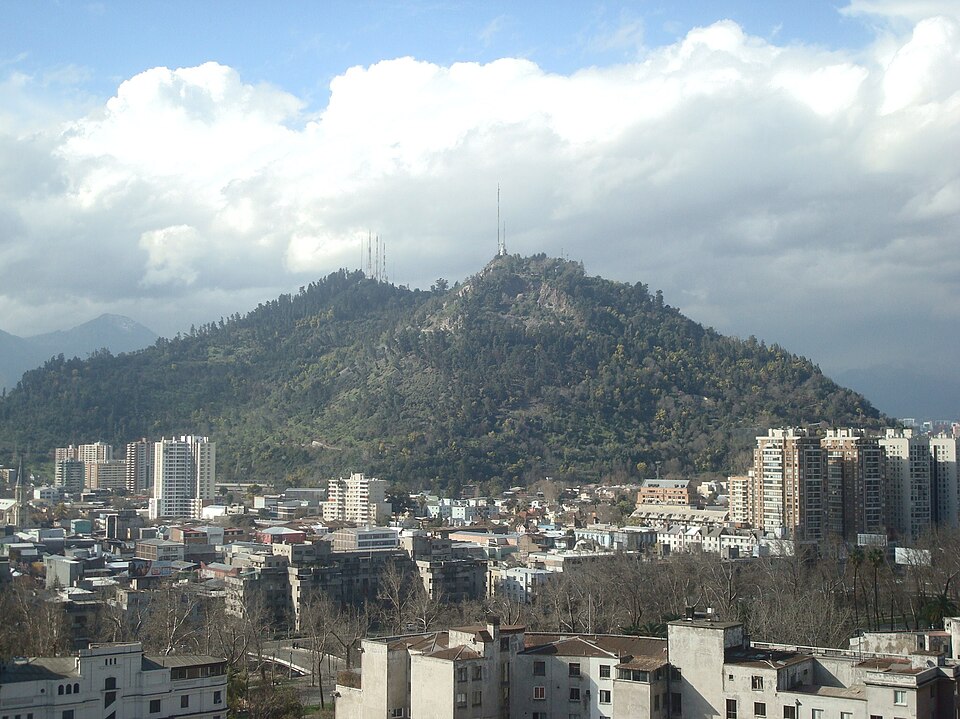
Photo: Carlos yo · CC BY-SA 4.0 · Wikimedia Commons Now climb San Cristóbal Hill, rising about 300 metres above the rest of Santiago. The Spanish named it after Saint Christopher because it served as a landmark, but its original indigenous name is Tupahue. At the summit you will find a sanctuary to the Immaculate Conception, with a 14 metre statue of the Virgin Mary on a tall pedestal, weighing 36,610 kilograms. Inside the pedestal is a small chapel where Pope John Paul the Second prayed and blessed the city in 1987. At night the statue is lit up and can be seen from all over Santiago.
Gran Torre Santiago

Photo: javier · CC BY 2.0 · Wikimedia Commons Look up at the Gran Torre Costanera, which locals simply call El Costanera. Rising 300 metres in the Sanhattan business district, it is the tallest building in South America. It was designed by Chilean architects Alemparte Barreda and Asociados together with the Argentine architect César Pelli and the Canadian company Watt International. The tower is part of the Costanera Center complex, which includes the largest shopping mall in Latin America, two hotels and two more office towers.
Santiago Metropolitan Cathedral

Photo: Felipe Restrepo Acosta · CC BY-SA 4.0 · Wikimedia Commons Facing the Plaza de Armas is the Santiago Metropolitan Cathedral, the main temple of the Catholic Church in Chile, dedicated to the Assumption of the Virgin Mary. Its builders took their time: the cathedral was constructed between 1748 and 1906, to designs by Joaquín Toesca and Ignacio Cremonesi. Many churches stood here before it, and the one you see is the fifth on this site. Together with the Archbishop's Palace and the Parish del Sagrario, it is a national monument.
Santa Lucía Hill

Photo: Dario Alpern · CC BY-SA 3.0 · Wikimedia Commons In the very centre of the city rises Santa Lucía Hill, about 69 metres above its surroundings, which the indigenous people called Huelén. It received its current name after Pedro de Valdivia took the hill on 13 December 1540, the feast day of Saint Lucy. Today it is a park of ornate facades, stairways and fountains, with a viewpoint at the top. In 1816 the Royal Engineers built two stone forts here, each able to hold eight or twelve cannons.
Valparaíso

Photo: Julia Sumangil · CC BY-SA 4.0 · Wikimedia Commons Our journey ends about 120 kilometres northwest of Santiago in Valparaíso, one of the Pacific Ocean's most important seaports, home of the Chilean Navy and seat of the National Congress. In the 19th century it was a major stopover for ships sailing between the Atlantic and Pacific through the Straits of Magellan, and sailors called it Little San Francisco and the jewel of the Pacific. It gave Latin America its oldest stock exchange and the continent's first volunteer fire department. Its hillside historic quarter became a UNESCO World Heritage Site in 2003.