 Sofa VoyageSuomeksi
Skopje

Welcome to Skopje, the capital and largest city of North Macedonia, lying in the Skopje Valley along the Vardar River. People have lived here since at least the Chalcolithic period. The Roman city of Scupi was destroyed by an earthquake in 518, and centuries later, in 1963, another major earthquake devastated the city, which was then largely rebuilt with international assistance. Over its long history Skopje was ruled by the Ottoman Empire for more than five centuries, and in 1991 it became the capital of an independent country. It is a city of many peoples and faiths. Let us start high above the river.
Sights
Skopje Fortress
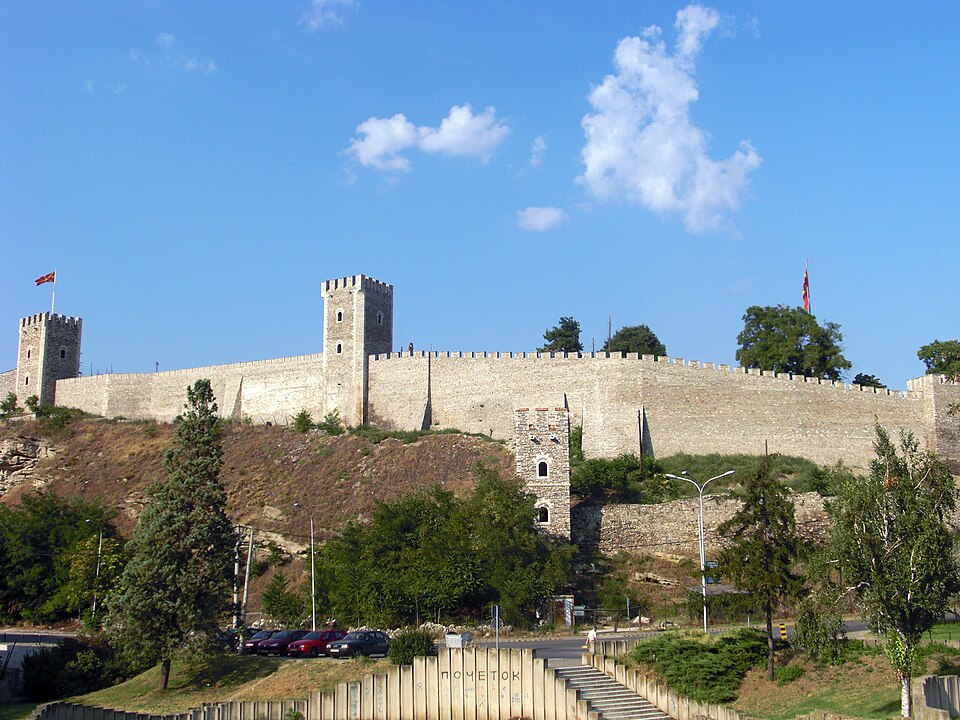
Photo: Yemc · Public domain · Wikimedia Commons On the highest point of the city, overlooking the Vardar River, stand the walls of the Skopje Fortress, known locally simply as Kale, from the Turkish word for fortress. The first fortress was built in the 6th century, on land inhabited since the Neolithic. Look closely at the stones: they include yellow limestone, travertine and even fragments of Latin inscriptions, taken from the Roman city of Scupi after the earthquake of 518. The fortress is so central to local identity that it appears on the city's coat of arms and flag.
Stone Bridge
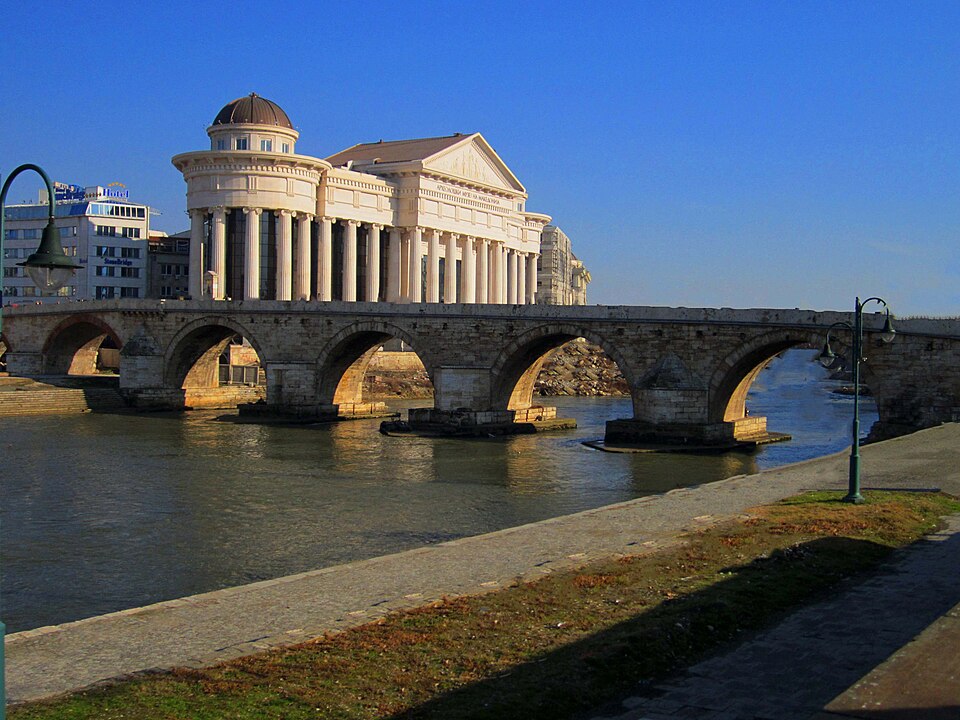
Photo: Делфина · CC BY-SA 3.0 · Wikimedia Commons Beneath your feet runs the Stone Bridge, the symbol of Skopje and the main element of the city's coat of arms. It links Macedonia Square with the Old Bazaar across the Vardar. The bridge was built on Roman foundations under the patronage of Sultan Mehmed the Second, the Conqueror, between 1451 and 1469. Its solid stone blocks rest on columns joined by 12 semicircular arches, stretching 214 metres. Over the centuries it was often damaged and repaired, and the great earthquake of 1555 destroyed or heavily damaged four of its pillars.
Old Bazaar

Photo: Stotosenik · CC BY-SA 3.0 · Wikimedia Commons Cross the river and you enter the Old Bazaar, one of the oldest and largest marketplaces in the Balkans. Merchants have traded here since at least the 12th century, and under Ottoman rule it grew into the city's main centre of commerce. Around you are signs of that era: roughly thirty mosques, numerous caravanserais and inns, alongside two churches and a clock tower. The bazaar survived earthquakes, the burning of the city in 1689 and two world wars, and in 2008 it was recognised by law as cultural heritage of particular importance.
Millennium Cross

Photo: Boredjohnn · CC BY-SA 3.0 · Wikimedia Commons Look up to the top of Vodno Mountain, and you will see the Millennium Cross, 66 metres tall and one of the tallest crosses in the world. It was built in 2002 as a memorial to 2,000 years of Christianity in Macedonia. Its open grid structure recalls the Eiffel Tower, and it stands on a platform of twelve columns representing the twelve apostles. Inside, a lift rises to the top, and from up there you enjoy the finest panorama of the capital spread out below.
Matka Canyon
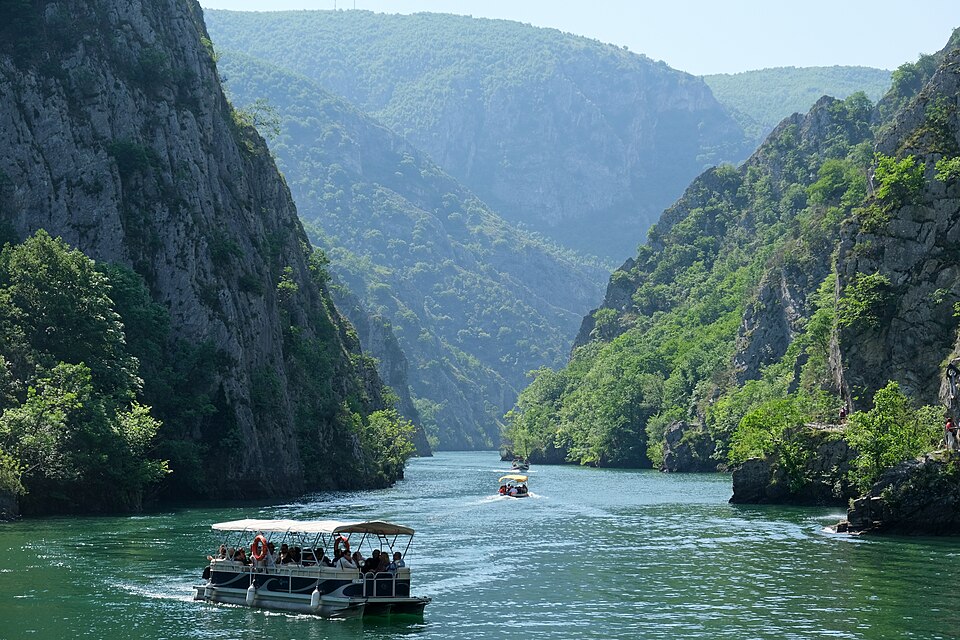
Photo: kallerna · CC BY-SA 4.0 · Wikimedia Commons Just west of central Skopje, the land folds into Matka Canyon, roughly 5,000 hectares of cliffs and water and one of the country's most popular outdoor destinations. Medieval monasteries cling to its slopes, and Matka Lake is the oldest artificial lake in North Macedonia. The canyon hides ten caves. The best known, Vrelo Cave, has a great stalactite nicknamed the Pine Cone, and at its far end lie two underground lakes, the larger one 18 metres deep.
Macedonia Square
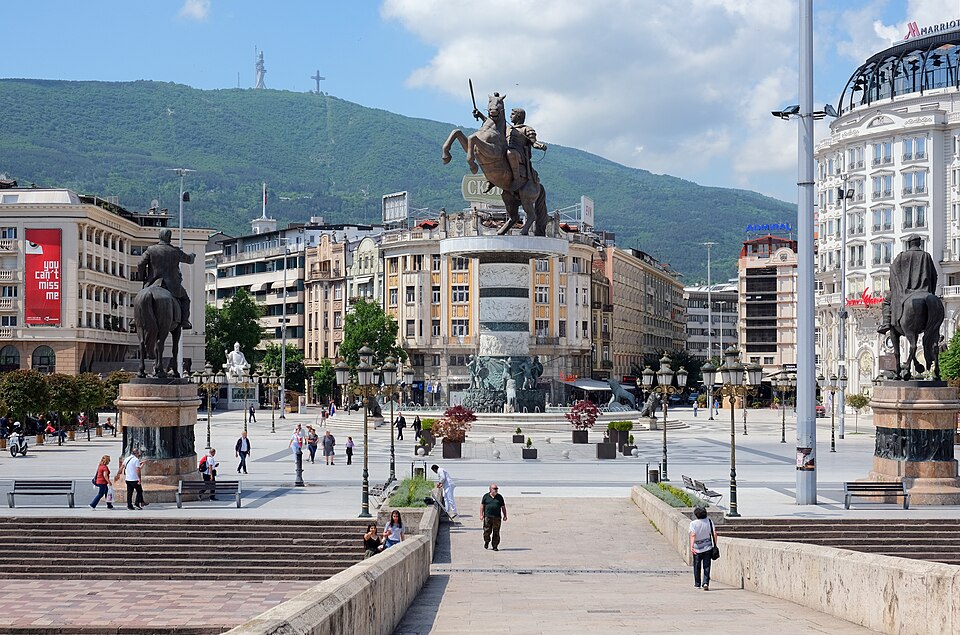
Photo: kallerna · CC BY-SA 4.0 · Wikimedia Commons You are now standing in Macedonia Square, the main square of Skopje and the largest in the country, covering 18,500 square metres and reaching across the Vardar River. This is where the city gathers for Christmas festivals, concerts and political events. It was here, too, that the first president, Kiro Gligorov, declared independence from Yugoslavia. Around you, many of the statues and buildings belong to the controversial Skopje 2014 project, which set out to reshape the city centre.