 Sofa VoyageSuomeksi
Yerevan

Welcome to Yerevan, the capital and largest city of Armenia and one of the oldest continuously inhabited cities in the world. It lies along the Hrazdan River at the edge of the Ararat Plain. The city's story begins in 782 BC, when King Argishti the First of Urartu founded the fortress of Erebuni here. Yerevan has been the capital since 1918, the fourteenth capital in Armenia's long history, and in the 20th century it grew from a provincial town into the nation's cultural, artistic and industrial centre. In 2012 UNESCO named it World Book Capital. Let us set out on our tour.
Sights
Yerevan Cascade

Photo: Textfabrikant · CC BY-SA 4.0 · Wikimedia Commons In front of you climbs the Cascade, a giant stairway of terraces, fountains, sculptures and exhibition halls linking the city centre with the hills of Kanaker to the north. The idea first appeared in the 1920s in architect Alexander Tamanian's master plan for Yerevan, which imagined terraces, waterfalls and flower beds rising up the slope. At the time it was judged too ambitious and went unfunded. Only after the Revived Armenia obelisk was raised on the plateau in 1967 did the plan return, to connect the centre with the monument above. Today it is one of the city's symbols and most visited places.
Republic Square
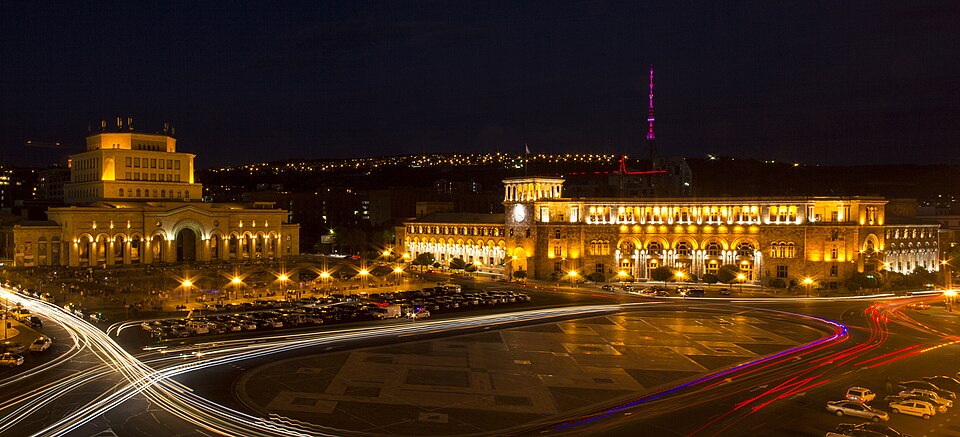
Photo: Sonanik · CC BY-SA 3.0 · Wikimedia Commons You have arrived in Republic Square, known to locals simply as Hraparak, the square. It has two parts: an oval roundabout and a trapezoid-shaped section with a pool of musical fountains. Around you stand five grand neoclassical buildings in pink and yellow tuff, richly decorated with Armenian motifs, among them the Government House and the History Museum and National Gallery. Alexander Tamanian designed the square in 1924. In Soviet times it was called Lenin Square, with a statue of Lenin at its centre, and it has often been described as the city's most outstanding architectural ensemble.
Tsitsernakaberd

Photo: Aleksey Chalabyan a.k.a Xelgen · CC BY-SA 4.0 · Wikimedia Commons We now come to Tsitsernakaberd, whose name means Swallow's Fortress. On this hill stands Armenia's official memorial to the victims of the Armenian genocide, built in 1967. Every year on 24 April, Armenian Genocide Remembrance Day, thousands of people gather here to remember the victims, laying fresh flowers out of respect for all those who died. Over the years, politicians, artists, musicians, athletes and religious figures from around the world have come to pay their respects. Please take a quiet moment as you approach.
Matenadaran

Photo: Gor Navoyan · CC BY-SA 4.0 · Wikimedia Commons Before you is the Matenadaran, officially the Mesrop Mashtots Institute of Ancient Manuscripts. It holds the most extensive collection of Armenian manuscripts in existence and works as a museum, archive and research institution all at once. It was established in 1959 from the nationalised collection of the Armenian Church, formerly kept at Etchmiadzin, and it has grown mostly through individual donations. The building is named after Mesrop Mashtots, the inventor of the Armenian alphabet, and his statue stands in front of it. The collection is listed in UNESCO's Memory of the World register.
Etchmiadzin Cathedral
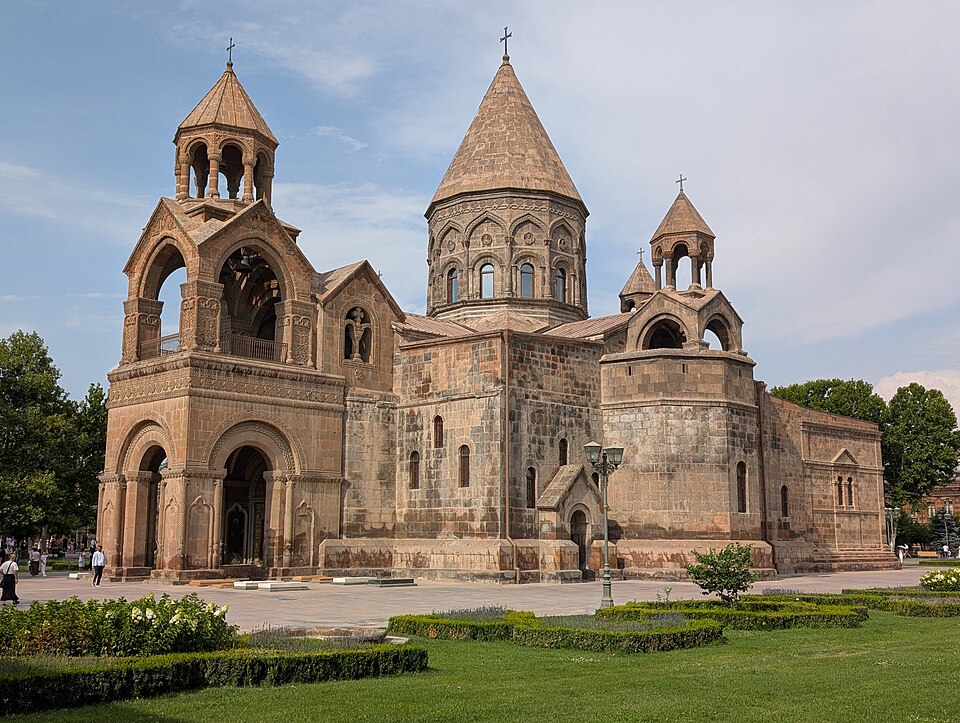
Photo: Yerevantsi · CC BY 4.0 · Wikimedia Commons Outside Yerevan, in the city of Vagharshapat, stands Etchmiadzin Cathedral, the mother church of the Armenian Apostolic Church and often regarded as the oldest cathedral in the world. According to tradition it was built between 301 and 303 by Gregory the Illuminator, after King Tiridates the Third adopted Christianity as the state religion. Fittingly, it was raised over a pagan temple, symbolising the conversion from paganism. The core of the present building dates from 483 or 484, rebuilt after a Persian invasion. Its belfries and later additions now combine styles from many periods of Armenian architecture.
Garni Temple
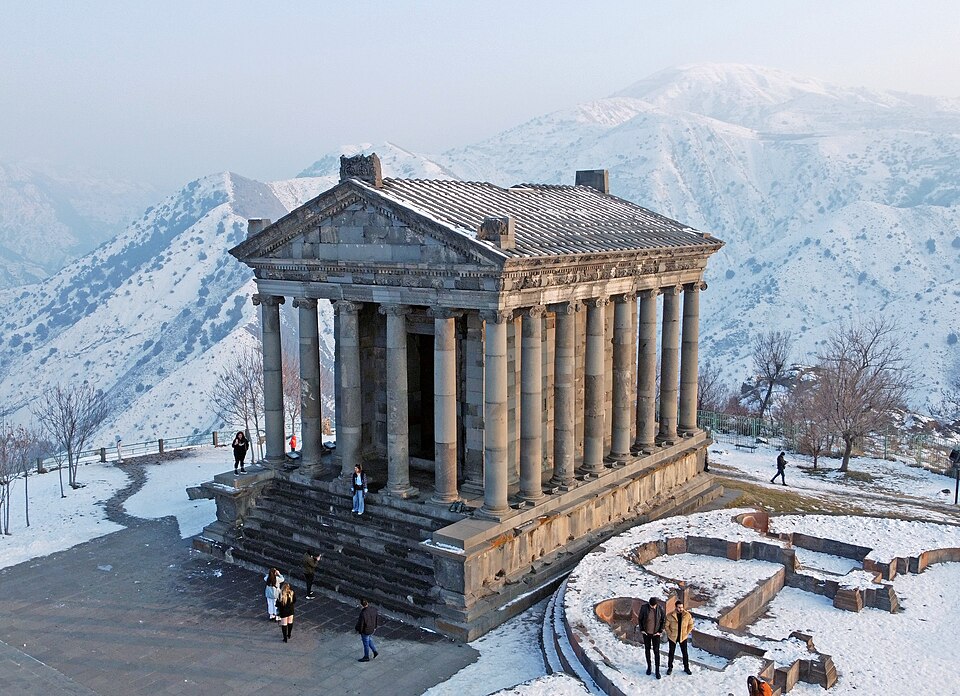
Photo: Yerevantsi · CC BY-SA 4.0 · Wikimedia Commons About 30 kilometres east of Yerevan, in the village of Garni, stands the Garni Temple, the best-known symbol of pre-Christian Armenia. With its Ionic columns, it is the only largely preserved Hellenistic building in the former Soviet Union, an eastern outpost of the Greco-Roman world. It is usually identified as a temple to the sun god Mihr, built by King Tiridates the First in the first century AD, although some see it as a tomb. It collapsed in an earthquake in 1679, but many fragments stayed on site, and in 1969 to 1975 it was rebuilt from its original stones.
Geghard

Photo: Diego Delso · CC BY-SA 4.0 · Wikimedia Commons Further up the Azat River gorge lies Geghard, a medieval monastery partly carved out of the mountain itself and surrounded by towering cliffs. It was founded in the 4th century by Gregory the Illuminator at a sacred spring inside a cave, and was first called the Monastery of the Cave. Its present name means the Monastery of the Spear, after the spear said to have wounded Jesus at the Crucifixion, which was once kept here among other relics. Some of its churches are dug entirely out of the rock. Visitors so often combine it with nearby Garni that the pair is simply called Garni-Geghard.